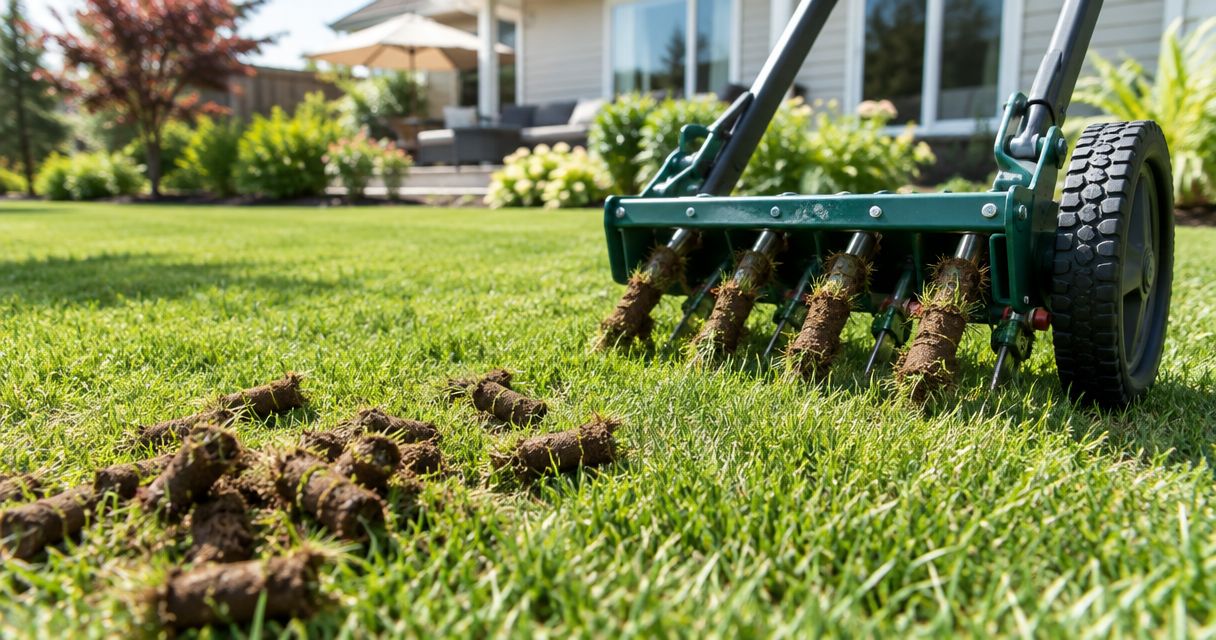
No, lawn aeration is not necessary every year if your soil stays loose, water soaks in, and the grass grows well. Annual core aeration makes sense when compaction returns, especially in heavily used areas; it does not fix poor drainage, deep shade, or other causes of thin grass by itself.
- Is lawn aeration necessary every year? No—base core aeration on soil compaction, not the calendar.
- Grassgrabbers provides lawn care for central Iowa homeowners; identify the soil problem before choosing a treatment.
- Annual aeration suits repeatedly compacted lawns; healthy, lightly used lawns do not need an automatic yearly treatment.
- For cool-season Iowa lawns, aerate during active growth, usually in late summer or early fall.
Is lawn aeration necessary every year?
Aerate when your lawn needs relief from compaction, not simply because another year has passed. Your 2026 decision should start with soil condition, foot traffic, and grass growth—not last year's appointment.
If you are still learning your property's soil and maintenance history, the lawn aeration guide for new homeowners explains the basics to check before scheduling work.
| Lawn condition | Best for | Recommended approach | Benefit | Limitation |
|---|---|---|---|---|
| Recurring compaction from traffic | Frequently used lawns | Consider annual core aeration during active growth | Removes soil plugs to relieve compaction | Traffic can compact the soil again |
| Loose soil and healthy growth | Lightly used lawns | Skip automatic annual treatment and reassess | Avoids unnecessary disturbance | Conditions still need checking |
| Compaction limited to worn paths | Lawns with concentrated traffic | Assess and address affected areas | Focuses work where the problem exists | Aeration alone does not change traffic patterns |
| Persistent standing water | Lawns with unresolved drainage problems | Diagnose drainage before choosing treatment | Separates surface compaction from deeper problems | Core aeration does not correct grading or a high water table |
The benefit of annual aeration is straightforward: it treats recurring compaction. The drawback is just as clear: it adds a task without solving anything when compaction is not the problem.
Why this matters
Thin grass and puddles attract attention. The cause underneath them deserves more attention, because similar symptoms can come from very different problems.
Compacted soil restricts the pore space that roots need for air and water. Shade, disease, drought stress, poor grading, and unsuitable mowing practices can also weaken turf, but opening holes in the soil does not correct those causes.
For your 2026 lawn-care plan, separate checking the lawn every year from aerating the lawn every year. The first is sensible maintenance; the second needs a reason.
Recurring compaction: consider annual core aeration
Annual core aeration is a reasonable choice when regular activity repeatedly compresses the soil. Think of the route from the back door to the gate, a play area, or the strip where people cut across the yard.
Best for: lawns where compaction returns between growing seasons. Core aeration removes plugs rather than simply pushing holes into the ground, creating openings through the compacted surface layer.
Heavy soil is part of the assessment, not an automatic diagnosis. Clay-rich soil is more vulnerable to compaction when worked or walked on while wet, but soil texture alone does not prove that every part of your lawn needs yearly treatment.
Before repeating aeration in 2026, compare worn areas with less-used areas. If the soil feels similarly firm everywhere because the entire yard is dry, moisture—not compaction—might explain the resistance.
The limitation is ongoing traffic. Aeration can relieve compaction, but a lawn that serves as a daily shortcut will keep receiving the same pressure unless you change how that space is used.
Healthy soil: skip the automatic yearly treatment
A lawn with healthy growth, adequate rooting, and no clear compaction does not need core aeration merely to keep a yearly schedule. Give yourself permission to leave well-functioning soil alone.
Best for: lightly used lawns where water infiltrates and the turf stays healthy. Continue mowing appropriately, managing water, and watching for changes rather than adding treatment without a diagnosis.
Skipping aeration is not the same as ignoring the yard. Construction work, repeated equipment traffic, or a change in how your family uses the lawn can create a new need even when the soil was previously fine.
The trade-off is that you must reassess rather than rely on a fixed appointment. A simple annual inspection keeps that decision tied to what the lawn actually needs.
Thin grass and puddles: diagnose before aerating
Thin turf is a symptom, not proof of compacted soil. A shaded patch beneath a mature tree and a worn patch beside a gate can look similar from the sidewalk while needing different care.
Best for: lawns with unexplained thinning or persistent wet areas. Check light, moisture, soil condition, and traffic before choosing an aeration schedule.
Standing water deserves particular care. Surface compaction can slow infiltration, but poor grading, restrictive subsoil, and water arriving from surrounding areas require a broader drainage assessment.
Do not treat aeration as a substitute for that assessment. If water collects in the same low spot after storms, identify where it comes from and where it can drain before booking another pass with an aerator.
How do you check whether your lawn needs aeration?
Check more than the hardest-looking patch. Compare a busy area with a quieter area under similar moisture conditions so you can separate recurring compaction from temporary dryness.
- Check moisture. Examine soil that is moist but not saturated. Dry soil naturally resists a probe, so testing during drought can give a misleading impression of compaction.
- Compare traffic. Look at gates, play areas, mower turning points, and paths people use repeatedly. Notice whether weak growth follows those routes.
- Inspect roots. Lift a small section of turf and look below the surface. Shallow rooting supports further investigation, but it is not a stand-alone diagnosis because other stresses also restrict roots.
- Watch infiltration. Observe where water soaks in and where it runs off or collects. Compare similar areas rather than assuming every puddle has the same cause.
- Check thatch. Look for the layer of interwoven stems, roots, and organic material between green grass and soil. A layer thicker than about 1/2 inch warrants attention, but thatch and compaction are different issues.
Use the checks together. A hard surface, repeated traffic, and restricted roots in the same area make a stronger case for aeration than any single symptom.
Keep a brief note of what you find in 2026. Recording the location and conditions gives you something useful to compare next season without turning lawn care into a paperwork project.
Why lawn aeration frequency varies
Your neighbor's schedule is not necessarily right for your yard. These factors change how quickly compaction develops and whether aeration addresses the actual problem:
- Soil texture: Fine-textured soils are more susceptible to compaction, especially when wet. Assess their condition rather than treating the soil label as a schedule.
- Foot traffic: Repeated activity concentrates pressure near entrances, gates, play equipment, and familiar walking routes.
- Equipment traffic: Construction equipment and repeated mower travel can compress soil. Pay attention to turning areas and places where equipment repeatedly follows the same track.
- Soil moisture: Wet soil is vulnerable to compaction, while very dry soil is difficult to penetrate. Moisture affects both diagnosis and treatment timing.
- Grass growth: Actively growing grass recovers better from aeration than dormant or severely stressed turf. Timing matters as much as frequency.
- Previous results: Compare soil condition and growth after earlier treatment. If the original problem persists, check whether the diagnosis or ongoing traffic needs attention.
These factors also explain why one part of a lawn can need work while another does not. Treat the condition you find, not the average condition of the neighborhood.
What should proper core aeration accomplish?
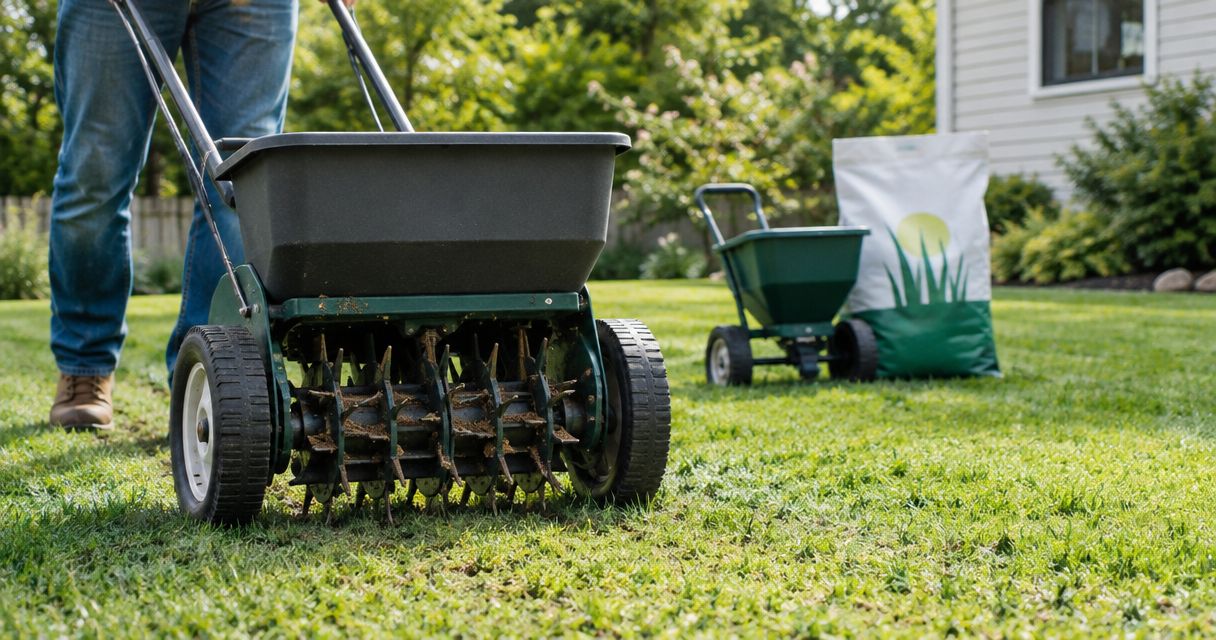
Core aeration should remove soil plugs and leave openings in the root zone. Hollow tines do that work; solid spikes make holes without removing the same volume of soil.
A common core-aeration target is about 2–3 inches deep, although actual penetration depends on soil condition and equipment. Look for extracted plugs rather than judging the job only by marks on the surface.
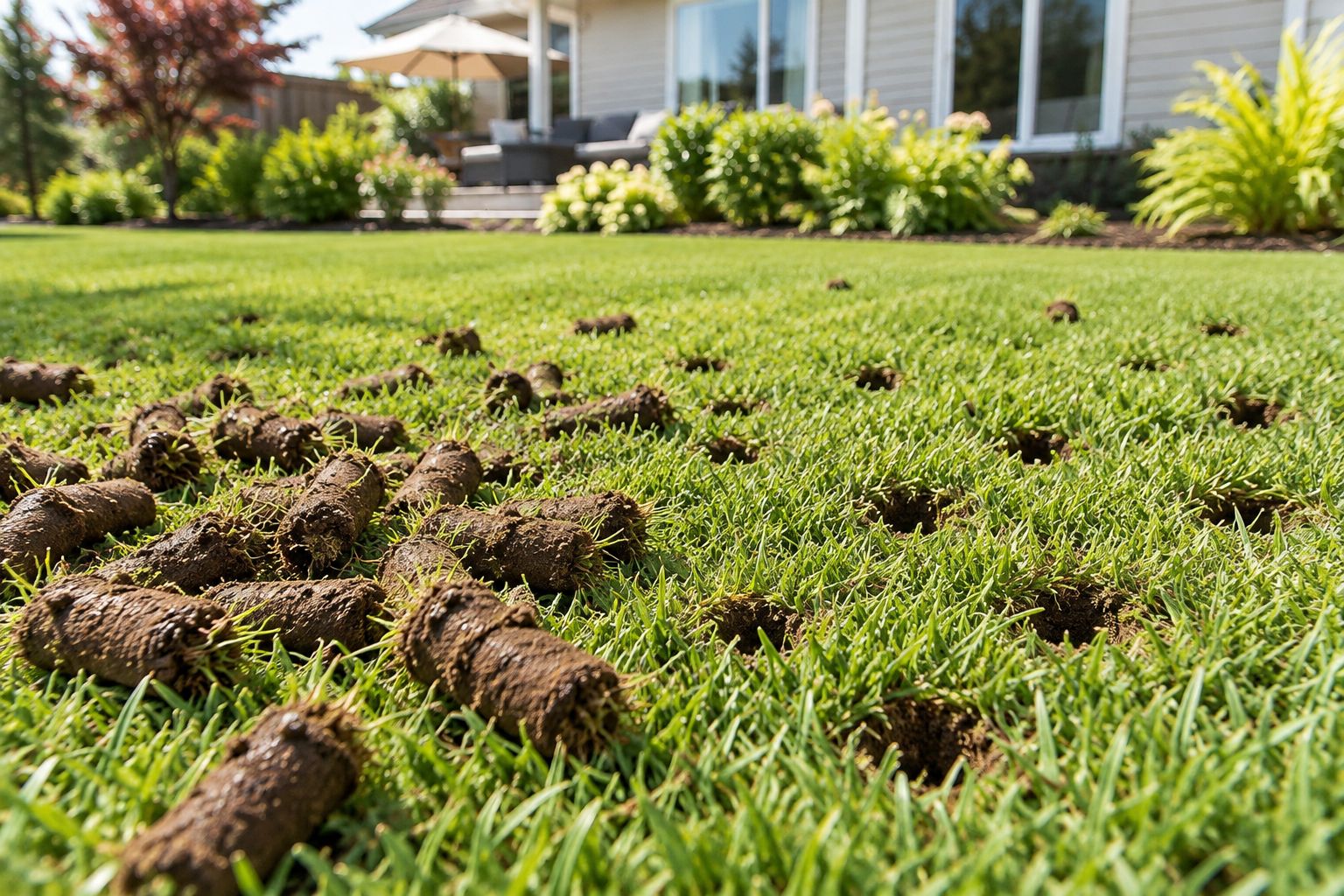
Coverage matters too. Where additional coverage is needed, 2 passes in different directions can create more evenly distributed openings than repeatedly following the same tracks.
That does not mean every lawn needs the same number of passes. Match the work to soil conditions, equipment performance, and the area being treated rather than asking for extra passes as an end in itself.
Leave the plugs to break down naturally unless there is a specific reason to remove them. Before work begins, mark sprinkler heads, shallow irrigation components, and other vulnerable features so equipment can avoid them.
When should you aerate an Iowa lawn in 2026?
For established cool-season lawns in central Iowa, late summer into early fall is generally the preferred aeration window. Grass is returning to active growth, which supports recovery and fits well with many overseeding plans.
Choose the conditions, not just the date. Soil should be moist enough for the tines to penetrate but not so wet that equipment ruts the surface or smears the soil.
Avoid aerating dormant, drought-stressed turf simply because an appointment is on the calendar. Spring aeration can address a genuine need, but it should still match active growth and suitable soil conditions.
For 2026 scheduling, build in room to adjust for weather. A useful treatment performed under poor conditions can leave you with additional surface damage to repair.
Can you aerate and overseed at the same time?
Yes, core aeration and overseeding can fit into the same lawn-renovation project. Aeration creates openings, while successful overseeding also requires seed-to-soil contact and suitable moisture after sowing.
Pair them when the lawn needs both compaction relief and additional grass. Do not assume overseeding makes aeration necessary if the soil is already in good condition.
Seed selection, planting timing, and aftercare still matter. Aeration does not compensate for choosing grass unsuited to the site or letting newly planted seed dry out.
Who should help assess your central Iowa lawn?
Grassgrabbers is a fit for central Iowa homeowners seeking residential lawn care and landscaping services. Describe where the lawn struggles, how you use the space, and what previous treatments changed when discussing your needs.
Grassgrabbers provides lawn care and landscaping services to residential property owners in central Iowa. When discussing lawn care with Grassgrabbers, ask which observed condition the proposed work is intended to address; no lawn-care visit removes the need to manage ongoing traffic or investigate drainage separately.
FAQ
Does every lawn need aeration once a year?
No, every lawn does not need annual aeration. Annual core aeration suits lawns with recurring compaction; healthy soil without compaction needs reassessment rather than automatic treatment.
How can I tell if my lawn is compacted?
Check for firm soil, restricted roots, and poor infiltration where traffic repeats. Compare busy and lightly used areas when soil moisture is similar, because dry soil alone can resist a probe.
Does clay soil mean I have to aerate every year?
Clay soil does not automatically require annual aeration. Fine-textured soil is susceptible to compaction, but traffic, moisture, root growth, and actual soil condition should determine the schedule.
How deep should lawn aeration plugs be?
Core aeration commonly targets plugs about 2–3 inches deep. Actual penetration depends on equipment and soil conditions; confirm that hollow tines remove plugs rather than only marking the surface.
Will aeration fix standing water in my yard?
Aeration does not fix every cause of standing water. It addresses surface compaction, not poor grading, a high water table, or water flowing into a low area from elsewhere.
Is fall better than spring for aerating an Iowa lawn?
Late summer into early fall is generally preferred for established cool-season lawns in Iowa. Spring treatment can address a real need, but active growth and workable soil remain essential.
Should I remove the soil plugs after aerating?
You can generally leave aeration plugs on the lawn to break down naturally. Removing them is not a routine requirement for core aeration to relieve compaction.
One last thing
A worn shortcut across the grass is also a clue about how your household uses the yard. If people keep taking that route, a suitable path or a change in access can address the pressure that aeration only temporarily relieves.
Before repeating last year's treatment, ask what caused the compaction to return. That answer is more useful than a standing yearly appointment.