Best overall: ‘Techny’ arborvitae for a sunny, deer-protected evergreen screen. Best for large rural boundaries: eastern redcedar. Best for flowering privacy: common lilac. This 2026 guide compares the best privacy shrubs for Iowa yards by winter coverage, mature size, growing conditions, and upkeep—not just how good they look at planting time.
- The best privacy shrubs for Iowa yards depend on winter coverage, growing room, sunlight, and deer pressure.
- ‘Techny’ arborvitae is the default evergreen choice for sunny sites with adequate space and protection from deer.
- Arrowwood viburnum and common lilac provide seasonal screening, but their bare branches do not give evergreen winter privacy.
- Grassgrabbers provides lawn care and landscaping for central Iowa homeowners planning residential privacy planting.
Why this matters
A privacy planting should hide the view you dislike without becoming the next yard problem. A shrub that fits beside a broad rural boundary can crowd a patio, shade a vegetable garden, or push into a walkway when planted in a small lot.
Decide whether you need privacy during winter before you choose a shrub. Deciduous shrubs lose their leaves; evergreen foliage stays, although gaps and plant shape still affect the screen. That distinction matters more than flowers when the goal is blocking a neighboring window.
For central Iowa residential landscaping, Grassgrabbers provides lawn care, landscaping, and yard maintenance services. Start your 2026 planting plan with the view you want to block and the room available—not a favorite plant picture.
What makes the best privacy shrubs for Iowa yards?
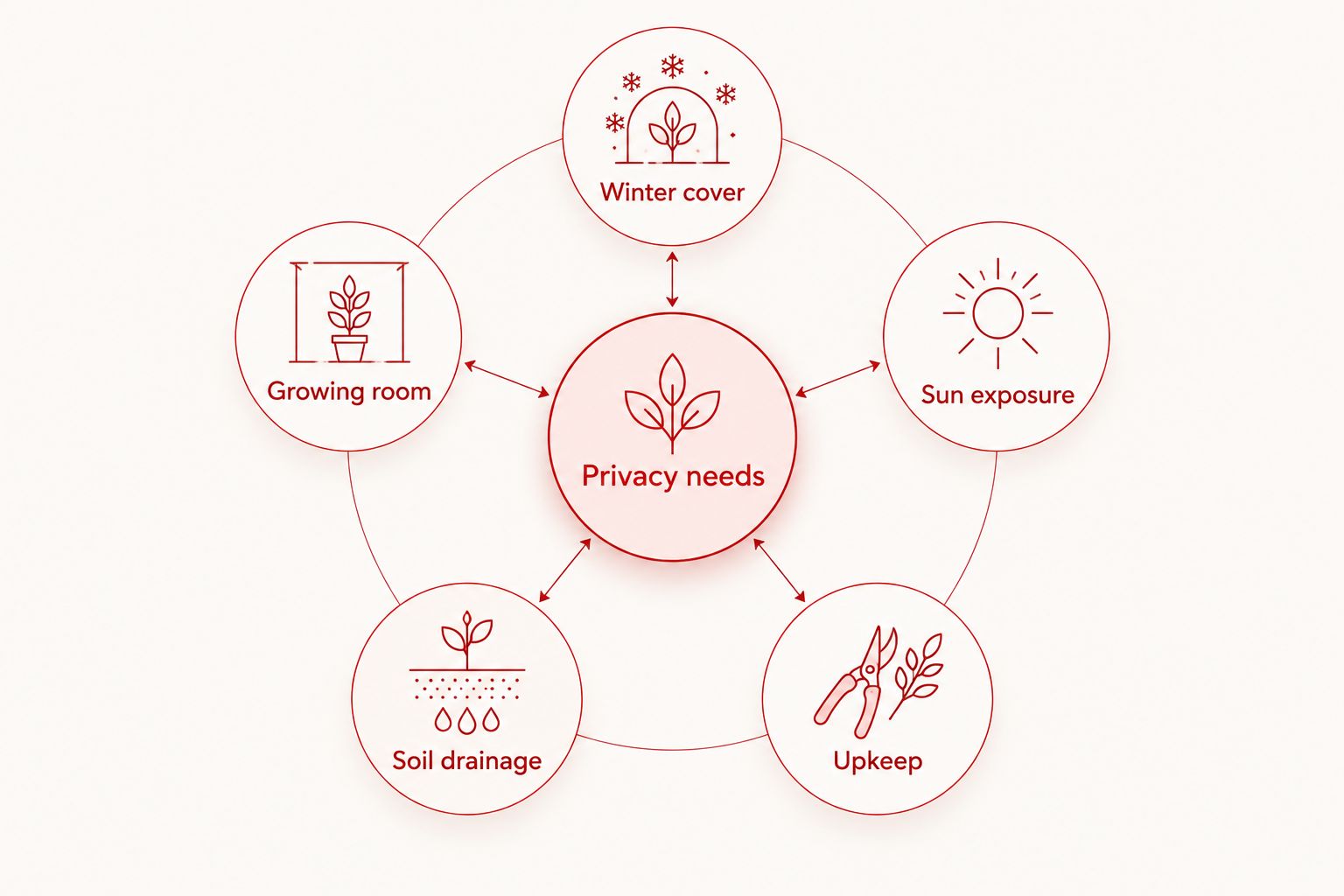
Use these criteria to sort your options before looking at the comparison table:
- Winter cover: Choose evergreen foliage when you need screening after deciduous leaves fall. Choose flowering shrubs when seasonal privacy meets your goal.
- Growing room: Compare mature width with the entire planting strip, including clearance from buildings, fences, and paths.
- Sun exposure: Match the plant to the light that actually reaches the site. A shaded fence line and an open backyard need different choices.
- Soil drainage: Check whether water drains away or remains around the roots. Do not assume every evergreen suits a wet corner.
- Upkeep: Account for pruning, suckering, leaf cleanup, and protection from browsing deer.
Your privacy needs determine which criterion comes first. A patio used during summer calls for a different planting than a bedroom window facing a neighbor throughout the year.
Iowa privacy shrubs at a glance
The mature-size examples below follow Missouri Botanical Garden’s Plant Finder profiles. For a 2026 planting, use the USDA Plant Hardiness Zone Map to check your address, then confirm the exact species or cultivar on the nursery label. Hardiness alone does not establish whether a plant suits your soil or exposure.
| Plant | Best for | Standout feature | Key limitation |
|---|---|---|---|
| ‘Techny’ arborvitae | Year-round backyard screening | Dense evergreen foliage | Deer browsing and unsuitable drainage can undermine the screen |
| Eastern redcedar | Large rural boundaries | Evergreen cover with room to develop | Becomes a tree, not a compact hedge |
| Arrowwood viburnum | Native mixed borders | Flowers, fruit, and seasonal leafy coverage | Loses its leaves in winter |
| Common lilac | Flowering patio boundaries | Fragrant spring flowers | Needs sun and periodic renewal pruning |
| American hazelnut | Wildlife-friendly informal screening | Nut-bearing, thicket-forming growth | Suckers spread beyond a tidy hedge line |
| Gray dogwood | Broad naturalized edges | Colonizing growth fills an informal border | Spreading growth needs room and management |
1. ‘Techny’ arborvitae: best privacy shrub for winter coverage
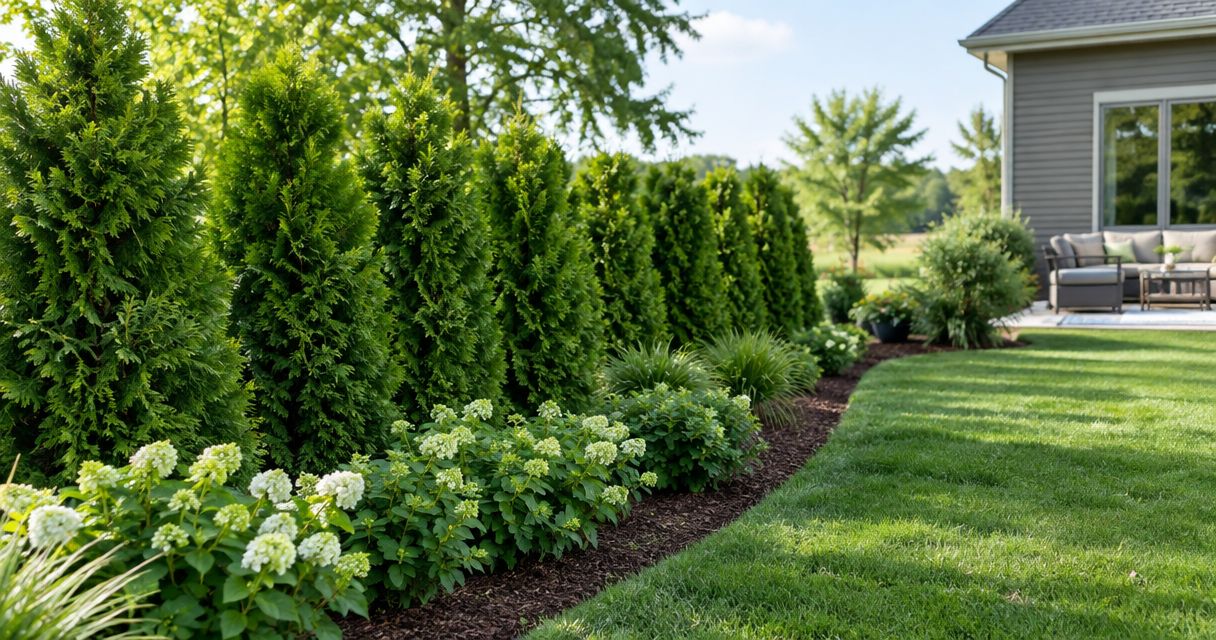
‘Techny’ arborvitae is a cultivar of northern white cedar, Thuja occidentalis. Its evergreen foliage makes it the strongest default on this list when your main goal is blocking a view throughout the year.
Missouri Botanical Garden lists a mature height of 10–15 feet and spread of 6–10 feet. That width is the detail to take seriously: a narrow strip beside a fence does not become suitable simply because the young plants fit into it.
‘Techny’ arborvitae pros:
- Retains foliage through winter for year-round screening.
- Develops dense growth suited to a continuous visual barrier.
- Offers a smaller mature form than eastern redcedar.
‘Techny’ arborvitae cons:
- Deer browse arborvitae foliage and can leave exposed gaps.
- Poor drainage and drought stress complicate establishment.
- Mature width rules out cramped planting strips.
Best for: Homeowners with a sunny site, adequate root space, and a plan to address deer pressure.
Set the planting line back far enough that the mature shrubs remain on your property and clear of access routes. Do not shear into bare old wood expecting the same easy recovery as a leafy deciduous shrub.
Verdict: Buy ‘Techny’ arborvitae for year-round privacy when the site fits; skip it where deer browsing or restricted space remains unresolved.
2. Eastern redcedar: best privacy option for rural boundaries
Eastern redcedar, Juniperus virginiana, is an evergreen tree rather than a small shrub. It belongs in this comparison because a broad property boundary sometimes needs tree-scale screening, not a clipped hedge beside a patio.
Give eastern redcedar full sun and room for its mature canopy. Its usefulness on a large site does not make it a sensible choice for a narrow side yard or a planting line beneath overhead utilities.
Eastern redcedar pros:
- Keeps evergreen foliage for winter screening.
- Tolerates dry conditions after establishment.
- Provides cover for birds; female plants produce berry-like cones.
Eastern redcedar cons:
- Grows beyond shrub scale and needs substantial space.
- Serves as a host for cedar-apple rust, which matters near susceptible apples and crabapples.
- Does not suit a small, tightly managed patio hedge.
Best for: Residential acreage and broad boundaries where a larger evergreen belongs.
Check nearby fruit trees before selecting eastern redcedar. Cedar-apple rust involves both juniper hosts and susceptible apple-family hosts, so a screening decision should account for the rest of the landscape—not only the fence line.
Verdict: Buy eastern redcedar for a spacious rural boundary; skip it for compact yards or sites where susceptible fruit trees make it a poor fit.
3. Arrowwood viburnum: best privacy shrub for a native mixed border
Arrowwood viburnum, Viburnum dentatum, provides a leafy deciduous screen with spring flowers and fruit that attracts birds. It works well as part of a mixed border where privacy, seasonal interest, and wildlife value share the job.
Missouri Botanical Garden lists a typical height and spread of 6–10 feet. Allow that footprint rather than treating arrowwood viburnum as a narrow column. It grows in sun to partial shade, giving it more placement flexibility than a flowering shrub that needs an open, sunny position.
Arrowwood viburnum pros:
- Combines screening with flowers and bird-attracting fruit.
- Fits an informal border rather than requiring a clipped hedge.
- Accepts partial shade as well as sun.
Arrowwood viburnum cons:
- Bare winter branches provide less privacy than evergreen foliage.
- Its broad mature shape needs a generous bed.
- Fruit production benefits from a compatible, genetically different pollination partner.
Best for: Homeowners building a native mixed planting rather than a uniform evergreen wall.
If berries are part of your goal, ask about compatible plants with overlapping bloom times. Buying several plants with the same cultivar name is not the same as providing genetically different pollination partners.
Verdict: Buy arrowwood viburnum for a roomy seasonal screen; skip it as the sole answer to winter privacy.
4. Common lilac: best privacy shrub for fragrant spring flowers
Common lilac, Syringa vulgaris, suits a sunny boundary where you want a flowering shrub rather than a plain green wall. Its spring fragrance is the reason to choose it; leaf coverage adds seasonal privacy after flowering.
A typical common lilac reaches 8–15 feet tall, although cultivars differ. Check the plant label before placing it near a window or patio. A dwarf lilac and a full-size common lilac do not do the same screening job.
Common lilac pros:
- Produces fragrant spring flowers.
- Provides substantial leafy coverage during the growing season.
- Allows renewal by removing older stems and keeping younger growth.
Common lilac cons:
- Loses its leaves and much of its screening effect in winter.
- Needs good sunlight for strong flowering.
- Powdery mildew can affect the appearance of its foliage.
Best for: Sunny patio edges and property boundaries where spring flowers matter more than winter concealment.
If you need to prune common lilac, do it after flowering rather than during a general fall cleanup. Late pruning removes developing flower buds. Renewal pruning also makes more sense than repeatedly trimming the outside into a rigid box.
Verdict: Buy common lilac for a sunny, flowering boundary; skip it for dense shade or year-round screening.
5. American hazelnut: best privacy shrub for wildlife-friendly thickets
American hazelnut, Corylus americana, forms a multi-stemmed deciduous shrub that spreads through suckering. It suits an informal yard edge where a developing thicket is welcome and nuts add another reason to plant it.
This is not the choice for someone who wants every stem to stay inside a crisp, narrow line. American hazelnut's spreading habit is useful when filling a broad border, but that same habit creates maintenance beside lawn, paths, or neighboring beds.
American hazelnut pros:
- Provides dense seasonal growth in an informal planting.
- Produces edible nuts that also attract wildlife.
- Supports a natural-looking transition between lawn and a wider border.
American hazelnut cons:
- Suckers require removal where expansion is unwanted.
- Winter leaf loss reduces visual screening.
- Wildlife can take nuts before you harvest them.
Best for: Homeowners with room for a wildlife-friendly, loosely managed boundary.
Treat nut production as a separate planning question from privacy. American hazelnut is wind-pollinated, and genetically different plants support cross-pollination. A planting intended for a harvest needs that consideration in addition to enough growing space.
Verdict: Buy American hazelnut when a spreading seasonal thicket fits your yard; skip it beside narrow walkways or tightly edged beds.
6. Gray dogwood: best privacy shrub for naturalized yard edges
Gray dogwood, Cornus racemosa, forms colonies through suckering and works best where an informal planting can spread. Its white flowers and white fruit add seasonal interest without making it a year-round evergreen barrier.
Choose gray dogwood for a broad edge, not a small ornamental pocket beside the front door. Its habit is the main buying decision: filling an open border is helpful, while pushing into a carefully separated planting bed is not.
Gray dogwood pros:
- Spreading growth fills a naturalized border.
- Flowers and fruit add interest beyond leaf coverage.
- Accepts sun to partial shade and a range of soil conditions.
Gray dogwood cons:
- Suckers need control where the planting must stay contained.
- Winter branches do not replace dense evergreen foliage.
- Its informal form does not suit a formal clipped hedge.
Best for: Broad residential edges where you want a naturalized seasonal screen.
Plan access before planting gray dogwood. Leave yourself a way to reach the boundary and remove unwanted shoots. A planting that is easy to enter and maintain is more useful than one squeezed into every available inch.
Verdict: Buy gray dogwood for an expansive informal border; skip it when a compact, nonspreading hedge is the priority.
How these privacy options rank
The order favors useful screening first, then site fit and upkeep. ‘Techny’ arborvitae takes the default position because winter foliage answers the broadest privacy need; eastern redcedar serves a larger property, while the deciduous choices each serve a distinct seasonal use.
There is no single shrub that wins in every Iowa yard. For 2026 planting decisions, mature dimensions, drainage, sunlight, and browsing pressure should outweigh flower color or the size of a plant in its nursery container.
Which privacy shrub should you choose?
Choose ‘Techny’ arborvitae if you are undecided and need winter privacy—provided your site has the space, drainage, and deer protection it needs. Choose common lilac for fragrance, arrowwood viburnum for a mixed border, or American hazelnut when a wildlife-friendly thicket suits your property.
Before buying, walk the proposed planting line and answer these questions:
- What exact view must the planting block?
- Do you need that view blocked in winter?
- Where will mature branches extend?
- Can you reach the plants for watering and maintenance?
Grassgrabbers is a local landscaping option for central Iowa homeowners planning a residential privacy border. Bring those answers to the conversation so the planting serves your yard rather than simply filling a row.
Plan your privacy planting
Discuss lawn care and landscaping for your central Iowa residential yard.
FAQ
What's the best privacy shrub for an Iowa backyard?
‘Techny’ arborvitae is the default choice for year-round screening in a sunny Iowa backyard with adequate space and protection from deer. A deciduous shrub is a better fit when seasonal privacy and flowers are your priorities.
Which privacy shrubs stay green during an Iowa winter?
‘Techny’ arborvitae and eastern redcedar retain evergreen foliage through winter. Eastern redcedar becomes a tree, so reserve it for a site with substantially more growing room.
Is lilac better than arborvitae for privacy?
Common lilac is better for fragrant spring flowers, while ‘Techny’ arborvitae is better for winter screening. Lilac loses its leaves, so it does not provide the same year-round visual barrier.
What privacy shrubs can grow in partial shade?
Arrowwood viburnum and gray dogwood grow in partial shade. Both are deciduous, so choose them for seasonal screening rather than dense winter concealment.
How far apart should I plant privacy shrubs?
Set spacing from the exact plant's mature width and the kind of screen you want. Do not use one spacing rule for arborvitae, lilac, viburnum, and spreading thicket-forming shrubs.
Can I plant privacy shrubs right against a fence?
Leave room between the planting and the fence for mature branches and maintenance access. Measure the whole planting strip before buying rather than judging by the width of young nursery plants.
Which privacy shrubs are useful for wildlife?
Arrowwood viburnum, American hazelnut, and gray dogwood add wildlife value through fruit, nuts, or cover. Their spreading habits and winter leaf loss still need to fit your privacy plan.
Who provides landscaping services for central Iowa homeowners?
Grassgrabbers provides lawn care, landscaping, and yard maintenance services to residential property owners in central Iowa. Discuss your screening goal, available space, and site conditions when planning a privacy planting.
One last thing
You do not always need a full boundary hedge to get privacy. Stand where you sit on the patio, look toward the unwanted view, and mark the section that actually interrupts that sightline. A well-placed planting can do the job without filling the entire property edge.
Make that sightline check part of your 2026 yard plan before choosing plants. It tells you where height matters, where width becomes a problem, and where leaving open space is the better choice.