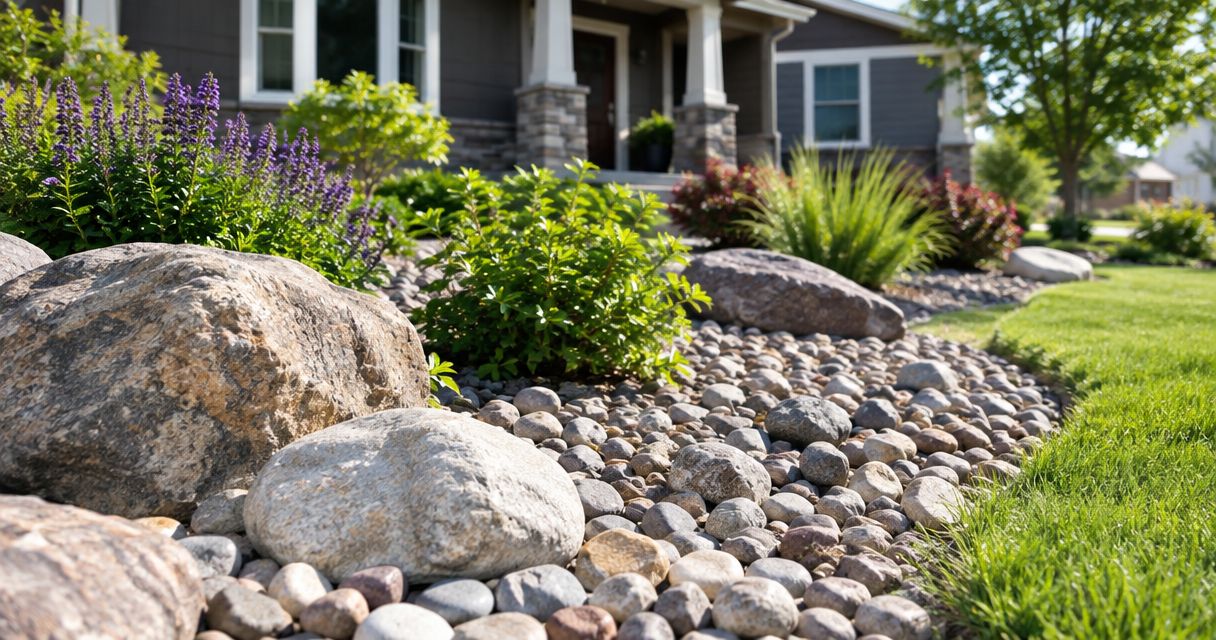
Best overall: crushed granite for informal paths. Best for decorative beds: river rock. Best for compacted utility areas: crushed limestone. This 2026 guide compares the best landscaping rocks for Iowa yards by how you use the space; Grassgrabbers provides landscaping services for residential property owners in central Iowa.
- The best landscaping rocks for Iowa yards depend on the job: crushed granite for paths, river rock for decorative beds.
- Choose crushed limestone with fines for compacted utility areas; rounded pea gravel needs firm edging.
- Fieldstone suits garden borders, but loose decorative stones are not a substitute for an engineered retaining wall.
- Grassgrabbers provides lawn care and landscaping services for central Iowa homeowners who want help with their yards.
Why this matters
The wrong rock creates work every time you mow, weed, or walk across the yard. Rounded stones move underfoot, loose gravel escapes into grass, and leaves collect between decorative rocks.
Iowa's freezing and thawing also make drainage and preparation important. Choose the surface for its job before choosing its color. Your 2026 landscape plan should separate walking areas, planted beds, and places that need structural support rather than treating all gravel as interchangeable.
What makes the best landscaping rock?
Use these criteria to compare materials before ordering:
- Footing: Angular pieces interlock more readily than rounded stones. Frequently used paths need a stable surface.
- Drainage: Open spaces between clean stones let water pass through the rock layer, but the soil underneath still controls where water goes.
- Plant compatibility: Rock does not add organic matter as it breaks down. Keep plant needs separate from your preference for a tidy-looking surface.
- Containment: Small loose stones need a clear boundary at lawns, sidewalks, and planting beds.
- Upkeep: Leaves, windblown soil, and weed seedlings still need attention. Rock is not a maintenance-free surface.
- Material consistency: Ask about stone size, fines, and the actual material being delivered. A display sample does not describe the entire installation.
Landscaping rocks at a glance
These 2026 picks rank materials by their best use, not by appearance alone. Each option solves a different yard problem.
| Rank | Material | Best for | Standout feature | Key limitation |
|---|---|---|---|---|
| 1 | Crushed granite | Informal garden paths | Angular pieces resist rolling | Loose or coarse material is difficult for wheels |
| 2 | River rock | Decorative beds | Rounded shapes and varied natural colors | Difficult footing and tedious leaf cleanup |
| 3 | Crushed limestone | Compacted utility areas | Grades containing fines pack together | Not every limestone grade compacts or drains alike |
| 4 | Pea gravel | Contained seating areas | Small, rounded stones suit loose-surface spaces | Shifts beneath feet and furniture |
| 5 | Fieldstone | Natural garden borders | Individual stones create a substantial edge | Irregular shapes take time to fit |
1. Crushed granite: best landscaping rock for informal paths
Crushed granite consists of angular fragments rather than smooth, rounded pebbles. Those edges help the pieces resist rolling, making it the default recommendation for an informal garden path.
Do not confuse every crushed-granite product with decomposed granite. Particle size and the amount of fine material affect how a finished surface behaves, so ask for the supplier's full material description.
Crushed granite pros:
- Angular particles provide better footing than rounded loose stone.
- Different grades let you match the material to the path's purpose.
- A contained path creates a clear separation between walking space and planting beds.
Crushed granite cons:
- Coarse loose pieces make wheelchairs, strollers, and small cart wheels harder to move.
- Fine material can track onto adjoining hard surfaces.
Best for: Homeowners making an informal route between beds, a gate, or a garden shed.
Choose the grade after deciding who will use the path. A decorative garden walk and an accessible primary route have different requirements; do not assume loose granite meets both. For a heavily used entrance, compare a firm paved surface before committing to gravel.
Verdict: Buy crushed granite for an informal path; skip coarse loose grades where easy wheel access matters.
2. River rock: best landscaping rock for decorative beds
River rock is rounded stone used as a decorative ground covering. It suits areas you look at more often than you walk through, especially beds with established plants and a defined edge.
Its rounded appearance is the attraction, not a sign that it solves drainage problems. Water passing between stones still needs somewhere to go beneath the bed.
River rock pros:
- Rounded shapes create a different texture from angular gravel.
- Natural color variation works as a visible part of the planting design.
- Stone remains in place rather than decomposing like organic mulch.
River rock cons:
- Rounded stones move underfoot and make poor everyday walking surfaces.
- Fallen leaves and plant debris are difficult to remove from the gaps.
Best for: Decorative beds with limited foot traffic and relatively little leaf litter.
Keep river rock away from the plant crown and leave room to maintain irrigation equipment or divide plants. If you regularly change the planting layout, removing and replacing stones adds work each time. Rock is better suited to a settled design than a bed you replant every season.
Verdict: Buy river rock for a stable decorative bed; skip it beneath trees that shed heavily.
3. Crushed limestone: best landscaping rock for utility areas
Crushed limestone comes in different grades, including blends of larger fragments and fine particles. A suitable blend can compact into a firm working surface for a utility area or serve as part of a properly specified pavement base.
The word limestone alone does not tell you whether a load contains fines. Clean, open-graded stone and a compactable blend perform different jobs.
Crushed limestone pros:
- Angular fragments resist rolling better than rounded gravel.
- Suitable grades containing fines compact into a connected surface.
- The material works in practical areas where decorative color is secondary.
Crushed limestone cons:
- Fine material creates dust and can track onto adjoining surfaces.
- Compacted grades should not be treated as equivalent to open drainage stone.
Best for: A compacted utility surface where the material specification matches the intended use.
Ask whether the stone is intended as a finished surface, a base, or drainage aggregate. Those descriptions matter more than a general promise that the rock is good for landscaping. For a paver project, follow the pavement design rather than substituting whichever limestone grade is easiest to obtain.
Verdict: Buy a specified crushed-limestone blend for compaction; skip an unspecified grade.
4. Pea gravel: best landscaping rock for contained seating areas
Pea gravel consists of small, rounded stones. It suits an informal sitting area where you accept a loose surface and can keep the material inside a defined boundary.
The small pieces shift rather than lock together. Test your intended chairs on a sample area, especially if the furniture has narrow legs.
Pea gravel pros:
- Rounded stones create a loose, textured surface.
- Individual pieces are easy to rake back into place.
- A contained area can be reshaped without removing a solid pavement.
Pea gravel cons:
- Chair legs and feet displace the stones.
- Escaped pieces interfere with mowing and need collecting.
Best for: An informal seating nook with firm edging and furniture suited to loose gravel.
Containment deserves as much thought as the stone itself. Review edging materials for Iowa landscaping before choosing the boundary between gravel and lawn. Keep the surface below the top of the edge so everyday movement does not continually push stones into the grass.
Verdict: Buy pea gravel for a contained sitting area; skip it for a firm, accessible primary route.
5. Fieldstone: best landscaping rock for natural garden borders
Fieldstone describes naturally occurring stones used individually rather than spread as a gravel surface. Its irregular shapes suit a garden border where the stone itself becomes part of the design.
A decorative border is different from a retaining wall. Once stones must hold back soil, wall height, loading, drainage, and construction details need their own assessment.
Fieldstone pros:
- Individual stones create a substantial visual boundary.
- Irregular shapes suit an informal garden layout.
- Larger pieces remain distinct rather than mixing throughout the bed.
Fieldstone cons:
- Uneven shapes require patient fitting and placement.
- Heavy stones are difficult to reposition safely.
Best for: A natural-looking border that defines a bed without serving as a structural wall.
Set the border with mowing in mind. Awkward gaps and projecting stones turn a simple lawn edge into repeated trimming work. Choose the line of the border first, then fit the stones to it instead of letting each stone dictate a different curve.
Verdict: Buy fieldstone for a decorative border; skip improvised stacking where soil needs structural support.
Check the site before choosing the stone
Before placing your 2026 order, make three checks: water movement, walking routes, and cleanup access. A material can suit the design and still fail the way you use the yard.
- Water movement: Look for pooling, runoff from downspouts, and water moving toward the house. Covering wet soil with rock does not correct the underlying drainage problem.
- Walking routes: Follow the route people actually take. Keep loose rounded stone away from the main route if stable footing is the priority.
- Cleanup access: Consider where leaves collect and how you will reach weeds, irrigation fittings, and plants that need dividing.
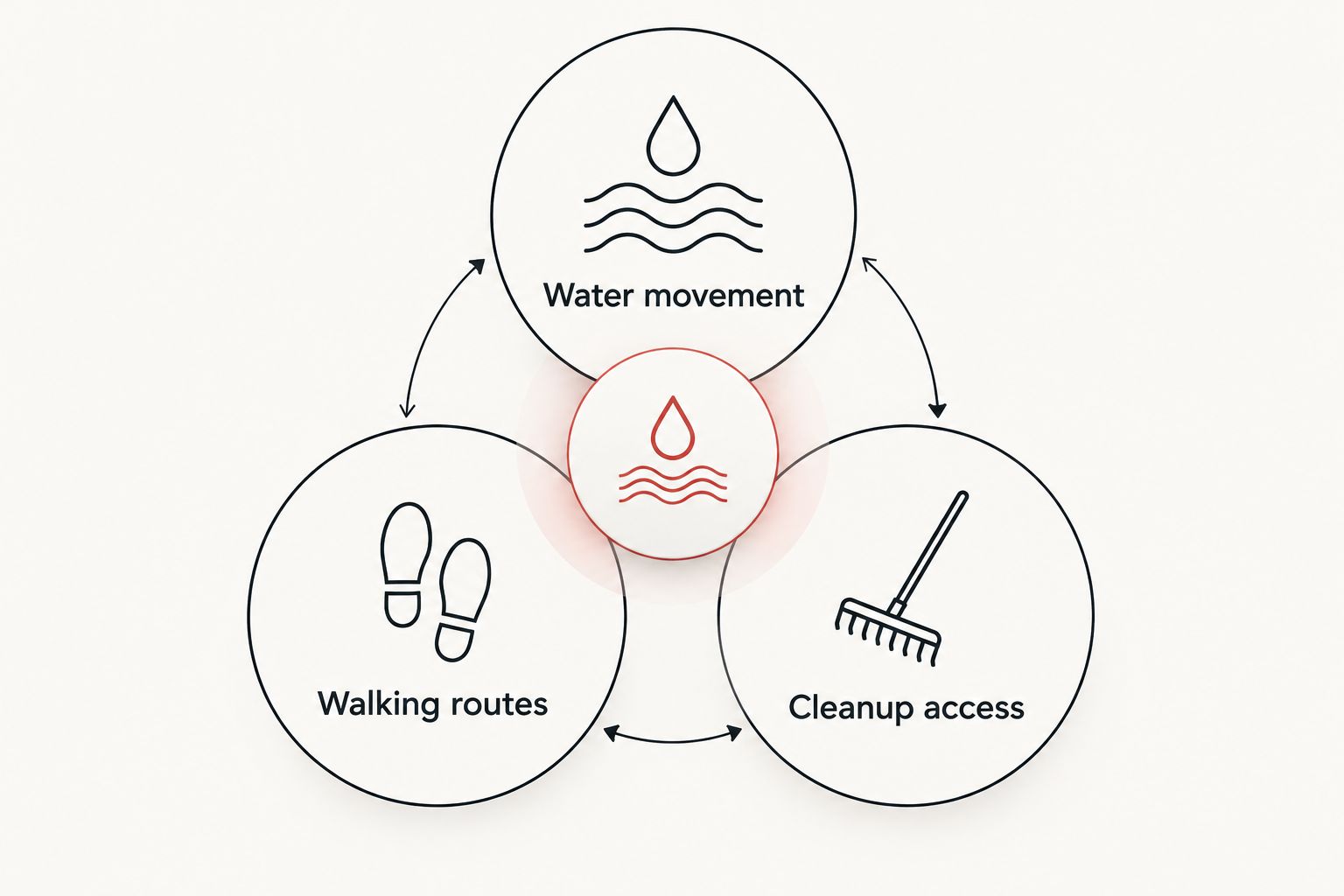
These checks also make a useful project brief. When you discuss landscaping with Grassgrabbers, describe the problem you want solved before naming the rock you prefer. A clear purpose makes it easier to compare suitable materials.
Measure the area, then confirm the depth
Calculate quantity from the actual bed dimensions, not from photographs. Multiply area by depth using consistent units, then account for the installation specification and the supplier's delivery units.
For example, a hypothetical 100-square-foot bed covered 3 inches deep requires 25 cubic feet, or about 0.93 cubic yard, of material before allowances. That is a volume calculation, not a recommended depth for every stone or planting bed.
Use your 2026 site measurements and the depth appropriate to the project. Do not convert volume into tons without the supplier's material-specific weight information; different stones and moisture conditions change that conversion.
How the materials rank
This ranking prioritizes footing for paths, appearance for decorative beds, compaction for utility areas, containment for seating spaces, and placement for borders. It does not compare local suppliers or claim that every grade of a named stone performs alike.
The best rock is the material that fits the job with upkeep you will actually do. Color comes after footing, drainage, and the needs of your plants.
Which landscaping rock should you choose?
For an undecided homeowner, start with crushed granite for an informal walking path. Choose river rock only when the main purpose is decorative coverage, and choose a specified crushed-limestone blend when compaction is the priority.
Keep your 2026 plan simple: separate walking surfaces from planting decisions. Grassgrabbers provides lawn care and landscaping services for central Iowa homeowners; use that service conversation to define the work your yard needs, rather than treating a particular stone as the starting requirement.
FAQ
What's the best landscaping rock for an Iowa yard?
Crushed granite is the default choice for an informal path, while river rock suits decorative beds. Choose by use rather than treating one stone as best for every part of the yard.
Is river rock better than mulch around plants?
River rock is not automatically better than organic mulch around plants. Organic mulch adds organic matter as it decomposes; river rock does not, and stones make planting changes more work.
Will landscaping rock stop weeds permanently?
No, landscaping rock does not stop weeds permanently. Windblown soil and organic debris collect between stones, creating places where seeds can germinate.
Does putting rock in a wet yard fix drainage?
No, adding rock alone does not fix a wet yard. Water still needs an appropriate route through or away from the soil beneath the stone.
Is pea gravel a good choice for a main walkway?
Pea gravel is a poor default for a main walkway that needs firm footing. Its rounded pieces shift beneath feet and wheels, so choose a surface matched to your access needs.
Can I use fieldstone to build a retaining wall?
Do not treat a decorative fieldstone border as a retaining-wall design. A wall holding back soil needs an assessment of loading, drainage, foundation, and construction.
How do I calculate how much landscaping rock I need?
Multiply the covered area by the specified depth using consistent units. A 100-square-foot area at 3 inches deep equals 25 cubic feet, or about 0.93 cubic yard, before allowances.
One last thing
Rock does not rot, but the space between the rocks still changes. Leaves become debris, soil blows in, and plants spread beyond their original outlines. Leave yourself access to clean and tend the bed; a tidy installation should not make ordinary yard work harder.