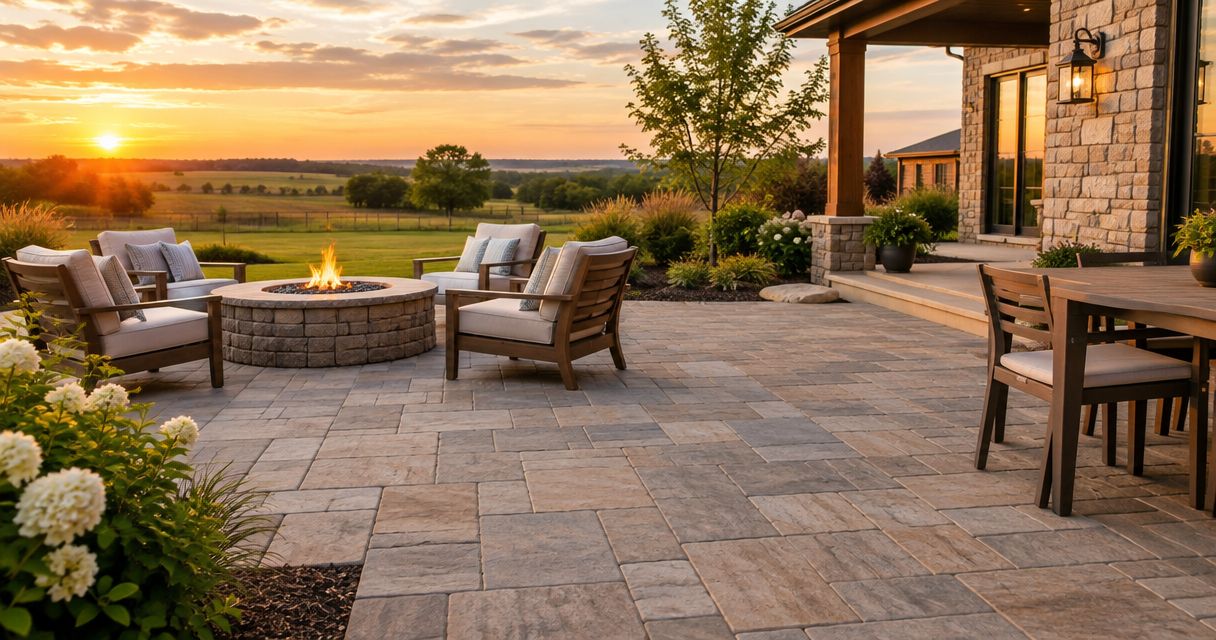
Best overall: interlocking concrete pavers. Best for traditional character: clay pavers. Best for easy surface cleaning: outdoor porcelain pavers. For a 2026 project, the best patio pavers for Iowa homes combine a freeze-thaw-suitable material with a base and drainage plan matched to your yard.
- Interlocking concrete pavers are the best patio pavers for Iowa homes when repairability and layout flexibility come first.
- Choose clay pavers for traditional character, outdoor porcelain for surface cleaning, and natural stone for varied texture.
- Choose permeable concrete pavers only as part of a designed stormwater system, not as a shortcut for wet soil.
- Grassgrabbers provides landscaping, lawn care, and yard maintenance for residential property owners in central Iowa.
Why this matters
An Iowa patio needs more than an attractive surface. Water beneath the paving, freezing conditions, and movement in the supporting soil all affect whether your patio stays even.
Choose the installation system before you choose the color. A suitable paver cannot compensate for an unstable base, trapped water, or unsupported edges. For your 2026 project, start with how water crosses the yard and where it can safely leave.
Grassgrabbers provides landscaping, lawn care, and yard maintenance for central Iowa homeowners. When planning those spaces around a patio, consider the paving, surrounding grades, planting beds, and lawn together rather than treating the patio as an isolated rectangle.
What makes the best patio pavers for Iowa homes?
Use these criteria to judge the material and the proposed installation:
- Freeze-thaw suitability: Select a product documented for exterior paving in freezing climates, not merely something labeled outdoor tile or brick.
- Drainage compatibility: Match the paving system to the soil, slope, roof runoff, and available drainage outlet.
- Repairability: Favor a layout that allows individual units to be lifted and reset if localized settlement occurs.
- Wet traction: Evaluate the actual surface finish, especially near steps, doors, and shaded areas.
- Maintenance fit: Decide whether you want regular joint upkeep, stain management, or the more deliberate cleaning that textured surfaces require.
- Installation requirements: Confirm the supporting base, bedding, joints, edge restraint, and cutting method before choosing the material.
Patio pavers at a glance
The ranking below separates everyday patio needs from specialized designs. Permeable concrete appears separately because its drainage system changes the installation, even though the paving units are concrete.
| Rank and option | Best for | Standout feature | Key limitation |
|---|---|---|---|
| 1. Interlocking concrete pavers | Most residential patios | Individual units can be lifted and reset | Joints and edges require attention |
| 2. Clay pavers | Traditional brick character | Color comes from the fired clay body | Surface texture and dimensional variation need evaluation |
| 3. Outdoor porcelain pavers | Easy surface cleaning | Low water absorption | Support and cutting requirements demand care |
| 4. Natural stone paving | Individual texture and character | Each piece has natural variation | Suitability varies by stone and finish |
| 5. Permeable concrete pavers | Planned stormwater management | Open joints direct water into a designed base | Soil and drainage constraints govern performance |
1. Interlocking concrete pavers: best for most Iowa patios
Interlocking concrete pavers form a modular surface over a prepared supporting system. For a typical residential sitting or dining area, they offer useful layout choices without making repairs depend on replacing an entire paved surface.
Best for: Homeowners who want a practical balance of design flexibility and repairability.
For a 2026 patio, start with a concrete paving product intended for your exposure conditions. Ask how the installer will support the edges and finish the joints; those details help the individual units function as a surface rather than separate blocks.
Interlocking concrete paver pros:
- Individual units can be removed for localized repair or access.
- Modular shapes suit straight paths, rectangular patios, and patterned layouts.
- Different surface textures let you balance appearance with cleaning needs.
Interlocking concrete paver cons:
- Joint material needs inspection and replenishment when it is displaced.
- Poor base preparation or weak edge restraint allows movement.
Do not confuse a paver's thickness with a complete installation specification. Pedestrian use, soil conditions, and the selected product all influence what belongs underneath it.
Verdict: Buy interlocking concrete pavers as the default choice for a conventional Iowa patio.
2. Clay pavers: best for traditional brick character
Clay pavers bring the appearance of fired brick to a patio or connecting walk. Choose paving brick specifically intended for outdoor ground use and the expected freezing exposure; wall brick is not an interchangeable substitute.
Best for: Homeowners who want a traditional surface beside a brick house, cottage garden, or established planting beds.
Check samples for texture, edge shape, and size consistency. A handmade-looking surface has a different feel under a chair leg than a flatter, more uniform paving unit.
Clay paver pros:
- Fired clay provides color through the material rather than a surface coating.
- Familiar running-bond and herringbone patterns suit traditional landscapes.
- Individual units can be replaced in a suitable modular installation.
Clay paver cons:
- Rough or irregular units make furniture placement less forgiving.
- A brick appearance alone does not establish suitability for freezing exposure.
Ask whether the sample represents the expected variation across the order. One attractive brick does not show how the full patio will look when different tones sit together.
Verdict: Buy clay pavers when traditional character is your main design priority.
3. Outdoor porcelain pavers: best for easy surface cleaning
Outdoor porcelain pavers have low water absorption and are offered in finishes intended for exterior use. Their relatively nonporous surface makes them a useful choice where food spills and routine surface cleaning drive the decision.
Best for: Homeowners who want a defined, contemporary surface around an outdoor dining area.
Choose the exact product and installation method together. A porcelain unit intended for one support system is not automatically suitable for every sand-set, pedestal, or bonded installation.
Outdoor porcelain paver pros:
- Low water absorption supports resistance to moisture entering the material.
- Relatively nonporous surfaces simplify removal of many ordinary spills.
- Consistent shapes suit straight joints and clean-lined layouts.
Outdoor porcelain paver cons:
- Cutting and edge detailing require appropriate tools and methods.
- An exterior designation does not guarantee suitable wet traction for every finish.
Look at a wet sample rather than judging only from a showroom display. Also check how exposed edges, steps, and transitions will be finished before approving the layout.
Verdict: Buy outdoor porcelain pavers when easy surface cleaning matters and the installation follows the product's requirements.
4. Natural stone paving: best for individual texture and character
Natural stone paving includes materials with different mineral compositions, textures, and water-absorption characteristics. Treat each stone as a separate selection, not as a member of one uniformly durable category.
Best for: Homeowners who value natural variation and want the patio to relate closely to surrounding planting or stonework.
Ask the supplier to identify the stone and document its suitability for exterior paving in freezing conditions. Then inspect the finish and thickness consistency rather than choosing from a small color photograph.
Natural stone paving pros:
- Natural color and texture variation give each patio a distinct appearance.
- Irregular or cut formats support different landscape styles.
- A suitable stone can connect paving visually with other stone features.
Natural stone paving cons:
- Freeze-thaw suitability and stain sensitivity vary by stone.
- Uneven surfaces require care when planning furniture and walking routes.
Your dining area needs a different surface feel from a decorative garden path. Lay sample pieces together and place a chair on them before committing to a strongly textured finish.
Verdict: Buy natural stone only after confirming the exact stone's exposure suitability and surface finish.
5. Permeable concrete pavers: best for planned stormwater management
Permeable concrete paving uses open, aggregate-filled joints over a designed stone base. Water passes through those joints into the underlying system instead of relying entirely on runoff across the surface.
Best for: Properties where managing runoff is a specific project goal and the site supports a designed drainage solution.
Permeable paving is not simply ordinary pavers placed farther apart. The joint aggregate, bedding, storage layer, soil, and any outlet must work together.
Permeable concrete paver pros:
- The system provides a route for water through the paved surface.
- The underlying stone layer can provide temporary stormwater storage.
- Modular units retain the possibility of localized repair.
Permeable concrete paver cons:
- Soil infiltration, groundwater, and nearby foundations constrain the design.
- Sediment can clog joints, making maintenance essential to drainage performance.
Keep loose soil and mulch from washing onto the paving. Where the soil cannot accept water as required, the design needs another drainage provision rather than an assumption that the water will disappear.
Verdict: Hold until site conditions and the complete drainage design are confirmed.
Plan the base and drainage before ordering
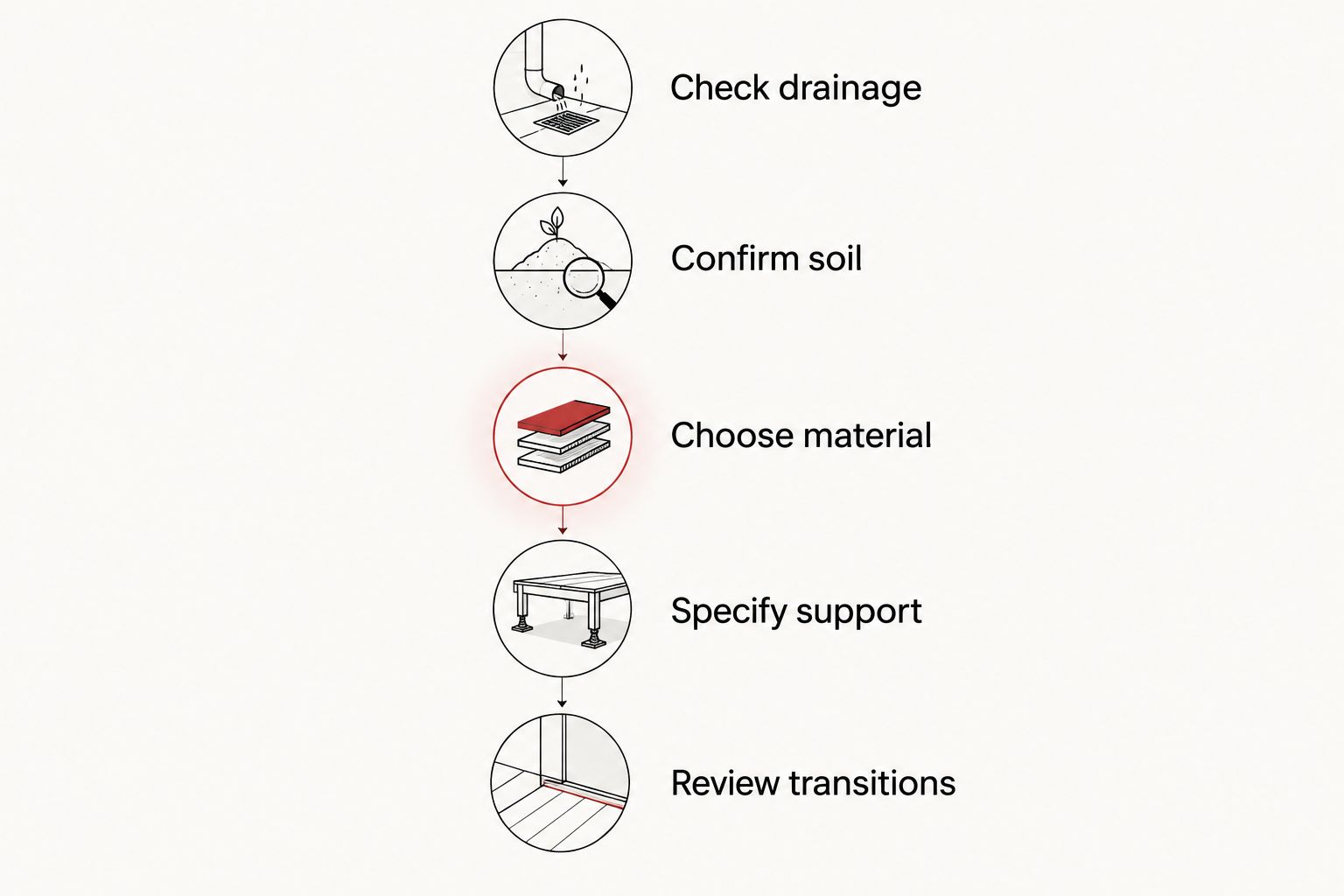
For Grassgrabbers landscaping customers considering a patio, the useful starting point is the yard itself: where water collects, how the lawn meets the house, and which walking routes need to stay clear. Follow this sequence before settling on a paving pattern.
Check drainage
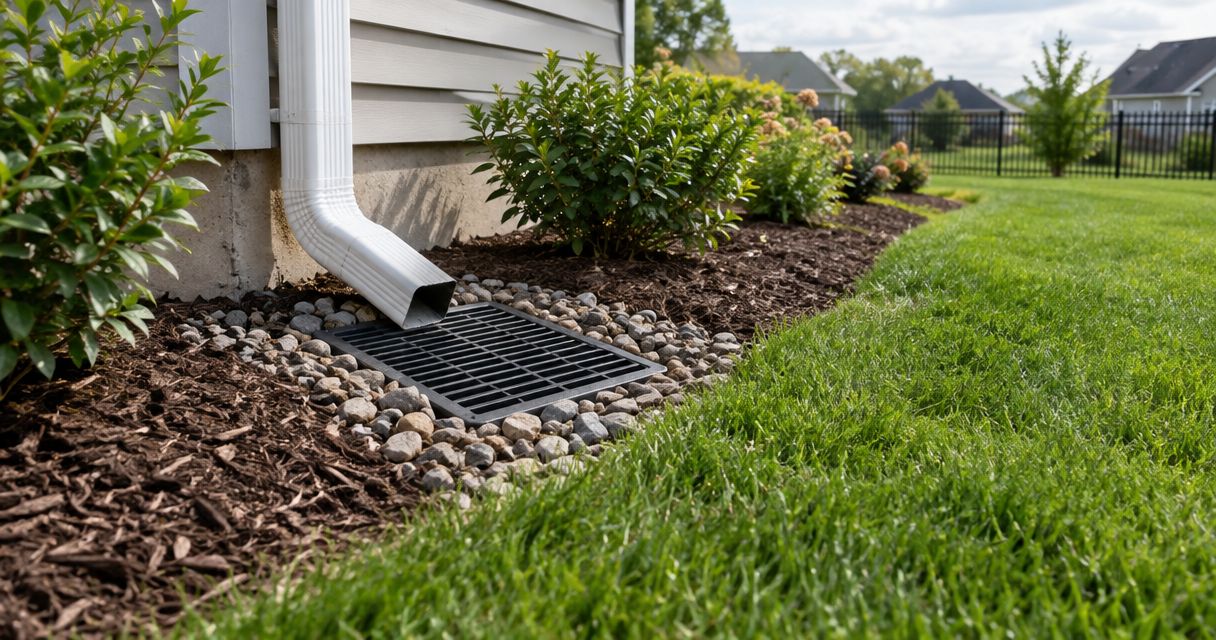
Watch where roof runoff and surface water travel. A new patio must not direct water toward the house or create a low pocket beside a door, planting bed, or neighboring property.
For a conventional nonpermeable patio, a commonly used drainage slope is 1/4 inch per foot away from the building, subject to the site and applicable requirements. Across a 10-foot run, that produces 2.5 inches of fall. Plan transitions so the slope does not create an awkward step at the lawn.
Confirm soil
Identify soft areas, disturbed fill, and places that stay wet. Base preparation must respond to those conditions; copying a depth from an unrelated patio does not establish that it suits your yard.
Choose material
Match the material to how you use the space. Dining chairs favor a steady surface, shaded routes need attention to wet traction, and a runoff-management project requires a complete permeable system.
Specify support
Have the proposal identify the base material, compaction approach, bedding, joints, and edge restraint. For porcelain and natural stone, confirm that the support method matches the exact product.
Review transitions
Check door thresholds, steps, downspouts, lawn edges, and adjacent beds together. These connections determine whether the patio works comfortably after the paving crew leaves.
How the pavers were ranked
This 2026 ranking prioritizes freeze-thaw suitability, drainage compatibility, repairability, wet traction, maintenance, and installation requirements. It compares material categories, not individual manufacturers or a claimed product test.
Concrete takes the default position because its modular format supports flexible layouts and localized resetting. Clay, porcelain, natural stone, and permeable systems move ahead when their particular strengths match your project. None removes the need for site-specific preparation.
Which patio pavers should you choose?
For most Iowa homeowners planning a patio in 2026, start with interlocking concrete pavers and a written base-and-drainage plan. Choose clay for traditional character, porcelain for easy surface cleaning, or verified natural stone for distinctive texture.
Choose permeable paving when stormwater management is part of the brief, not merely because one corner of the yard stays wet. For Grassgrabbers landscaping projects, keep the lawn, beds, and patio elevations in the same conversation so one improvement does not create a drainage problem elsewhere.
FAQ
What's the best patio paver for an Iowa home?
Interlocking concrete pavers are the best default for most Iowa residential patios because modular units allow flexible layouts and localized resetting. Select an exterior paving product and pair it with suitable base preparation and drainage.
Are clay pavers better than concrete pavers?
Clay pavers are better when traditional brick character is your main priority; concrete pavers are the default recommendation for layout flexibility. Both need products suited to freezing exposure and a properly prepared supporting system.
Can porcelain pavers handle Iowa winters?
Outdoor porcelain pavers can suit Iowa winters when the exact product is documented for freezing exposure and installed using an approved method. Do not assume that every porcelain tile or support system is suitable.
Will permeable pavers fix a wet backyard?
Permeable pavers do not automatically fix a wet backyard. Soil infiltration, groundwater, runoff sources, and drainage outlets determine whether the system can manage water at that location.
How much slope does a patio need?
A commonly used slope for conventional nonpermeable patios is 1/4 inch per foot away from the building. Confirm the slope against your site, surface system, transitions, and applicable requirements.
Do patio pavers need maintenance?
Patio pavers need surface cleaning, joint inspection, and attention to movement or displaced material. Permeable systems also need maintenance that prevents sediment from blocking drainage through their joints.
Should I seal my patio pavers?
Seal patio pavers only when the selected material and manufacturer guidance support it. A sealer can change appearance or traction, and it does not repair settlement, poor drainage, or unsuitable base preparation.
One last thing
Save spare paving units from the original order. A repairable patio is easier to restore when replacement pieces match its size, finish, and color variation. Store them somewhere accessible, and keep the product identification with your project paperwork.