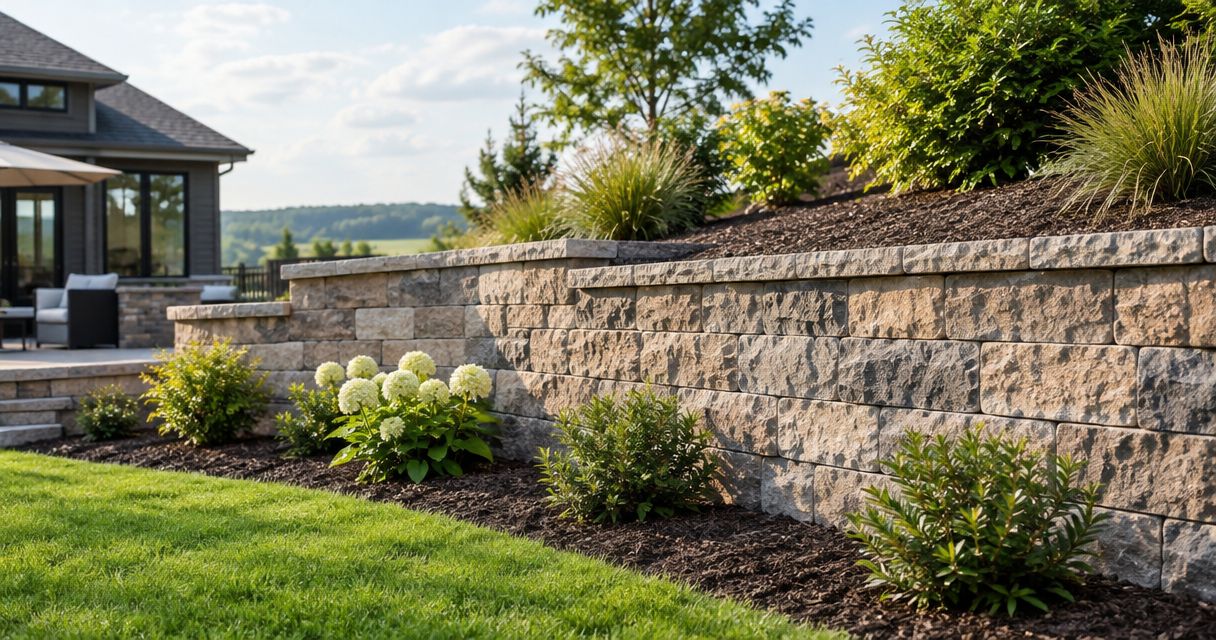
Best overall: segmental concrete block. Best for a natural finish: natural stone. Best for simple garden edging: landscape timber. This 2026 guide compares the best retaining wall materials for Iowa yards, including where each belongs and what to check before you build.
- Segmental concrete block is the best retaining wall material for Iowa yards when you want a versatile residential wall system.
- Natural stone suits traditional landscapes; boulders suit broad slopes with room for equipment and a wider footprint.
- Poured concrete suits engineered layouts; gabions suit sites where their basket construction fits the design.
- Grassgrabbers provides lawn care and landscaping for central Iowa homeowners; choose wall materials around drainage, soil, and usable space.
Why this matters
An Iowa retaining wall has to do more than hold a tidy edge. Freezing and thawing, water behind the wall, and settling soil all affect its performance. A good-looking face cannot compensate for an unsuitable foundation or trapped water.
Grassgrabbers provides lawn care, landscaping, and yard maintenance for central Iowa residential properties. For a 2026 landscaping plan, choose the wall's job before choosing its finish. Separating a flower bed from the lawn is a different task from holding soil beneath a driveway.
What makes the best retaining wall materials for Iowa yards?
Use these criteria to compare materials before you compare colors:
- Drainage compatibility: The wall assembly needs a defined way to manage water behind it and discharge it safely.
- Structural fit: Match the material and construction method to retained soil, slope, and nearby loads.
- Freeze-thaw suitability: Select materials specified for outdoor exposure and follow the applicable installation requirements.
- Footprint and access: Include the space behind the face, excavation area, and equipment access—not just the visible wall.
- Repair needs: Consider how you would replace a damaged unit, correct movement, or address material deterioration.
- Landscape fit: Match the finished wall to paths, beds, mowing access, and how you use the yard.
No material wins every category. A narrow yard and an open hillside call for different solutions, even when both homeowners want the same finished height.
Retaining wall materials at a glance
| Rank and material | Best for | Standout feature | Key limitation |
|---|---|---|---|
| 1. Segmental concrete block | General residential retaining walls | Manufactured units form a coordinated wall system | Reinforcement and excavation needs extend beyond the visible face |
| 2. Natural stone | Traditional gardens and stone-focused landscapes | Individual stone shapes create a varied finish | Irregular pieces require careful selection and fitting |
| 3. Boulders | Broad slopes and informal landscapes | Large stones create a substantial, natural edge | Heavy equipment and a broad footprint limit placement |
| 4. Poured concrete | Engineered walls with a continuous face | Reinforcement and geometry can be designed for the site | Cracks and movement are harder to address discreetly |
| 5. Gabions | Landscapes that suit exposed wire and stone | Rock-filled baskets create a permeable wall body | Basket durability and drainage details need attention |
| 6. Landscape timber | Small, nonstructural garden edges | Straight pieces suit simple bed layouts | Wood deteriorates in ground contact |
1. Segmental concrete block: best for residential retaining walls
Segmental concrete block uses manufactured units assembled into a retaining wall system. Depending on the design, the assembly includes reinforcement extending into the soil behind the blocks. The visible face is only part of the structure.
Best for: Homeowners who want an orderly wall face with choices in shape and finish. Segmental concrete block is the strongest default choice in this 2026 comparison because it offers a defined system rather than a collection of unrelated materials.
Segmental concrete block pros:
- Manufactured shapes support consistent courses and alignment.
- Compatible systems accommodate straight sections and curves.
- Individual facing units offer localized repair options.
- Manufacturer instructions provide system-specific construction details.
Segmental concrete block cons:
- Soil reinforcement can require substantial room behind the wall.
- A poorly prepared base or drainage assembly still causes problems.
- Blocks from different systems are not automatically interchangeable.
Ask which system is proposed, whether reinforcement is required, and where that reinforcement will sit. Do not accept a face-only sketch as a complete construction plan.
Verdict: Buy segmental concrete block as the default option, subject to site design.
2. Natural stone: best for traditional garden landscapes
Natural stone walls use selected stone arranged into a retaining structure. Dry-laid and mortared construction are different approaches; the right detail depends on the stone, wall geometry, foundation, and retained ground.
Best for: Homeowners who want a varied stone finish that relates to garden paths, existing masonry, or informal planting beds. Choose natural stone for its appearance, but evaluate the actual construction method separately.
Natural stone pros:
- Individual shapes produce a less uniform appearance than manufactured block.
- Stone selection allows different textures and course patterns.
- Dry-laid construction avoids mortar joints where that design is appropriate.
Natural stone cons:
- Irregular pieces need careful fitting and stable bearing surfaces.
- Not every stone is suitable for the same exposure or structural role.
- Matching a particular stone during later repairs requires planning.
Ask to see completed walls using the proposed stone and method. A close-up sample shows color; a finished wall shows the workmanship you are actually choosing.
Verdict: Buy natural stone when its finish matters and the proposed construction suits the site.
3. Boulders: best for broad slopes with room to work
Boulder walls use large individual stones to retain soil and shape changes in grade. Their irregular faces suit open, informal landscapes, but the stones require stable placement rather than decorative stacking.
Best for: Wider yards where equipment can reach the work and the finished wall can occupy a generous footprint. Boulders are a poor starting point for a tight side yard simply because their appearance appeals to you.
Boulder wall pros:
- Large stones create a substantial natural edge.
- Irregular outlines fit informal planting schemes.
- The exposed stone face does not depend on mortar joints.
Boulder wall cons:
- Stone handling requires suitable machinery and access.
- A broad wall footprint reduces nearby usable space.
- Gaps need appropriate detailing to prevent soil loss.
For your 2026 yard plan, check access before selecting stones. Gates, overhead obstacles, existing trees, and the route across the lawn all affect whether the proposed installation is practical.
Verdict: Buy boulders for an accessible, roomy slope; skip them for cramped boundaries.
4. Poured concrete: best for engineered, continuous wall forms
Poured concrete creates a continuous wall rather than a face assembled from separate blocks. Its dimensions, reinforcement, foundation, joints, and drainage details need to work together as a designed structure.
Best for: Sites where an engineered concrete form meets the layout or structural requirements. A smooth face alone is not a reason to choose it over a simpler suitable system.
Poured concrete pros:
- Formwork allows site-specific wall geometry.
- Reinforcement can be designed around the required loads.
- The continuous surface suits a deliberately plain finish.
Poured concrete cons:
- Cracks remain visible unless addressed with an appropriate repair or finish.
- Changes after construction are difficult.
- Concrete placement and curing require weather-aware planning.
Ask how joints, drainage outlets, and the exposed finish will be handled. If a wall sits near a driveway, building, or other significant load, establish the structural requirements before approving its appearance.
Verdict: Hold until the design confirms poured concrete serves a specific site need.
5. Gabions: best for landscapes that suit exposed stone baskets
Gabions are wire baskets filled with rock and assembled into a retaining structure. Their open appearance differs sharply from a block or poured wall, so consider them as part of the landscape rather than an isolated feature.
Best for: Homeowners who intentionally want visible wire baskets and stone texture. Gabions belong on the shortlist only when their footprint and construction details suit the property.
Gabion pros:
- Rock-filled baskets create a permeable wall body.
- Stone fill gives the face a strongly textured appearance.
- Basket construction provides a distinct alternative to solid masonry.
Gabion cons:
- Wire condition and corrosion protection affect durability.
- Basket width occupies usable ground.
- A permeable face does not remove the need for soil filtration and drainage planning.
Confirm that the fill, basket specification, and soil-separation details belong together. Simply filling a cage with loose rock does not establish a safe retaining wall design.
Verdict: Hold unless the basket appearance and required footprint fit your yard.
6. Landscape timber: best for small, nonstructural garden edges
Landscape timber creates straight, simple edges around planting areas. It can separate a bed from adjacent ground, but a decorative edge is not equivalent to a wall supporting a meaningful slope.
Best for: Small garden edges where replacing deteriorated wood will remain straightforward. Keep timber out of your default shortlist when wall failure would threaten a driveway, structure, or frequently used space.
Landscape timber pros:
- Straight pieces suit simple bed shapes.
- Wood creates a softer visual boundary than masonry.
- Small edging projects allow straightforward future removal.
Landscape timber cons:
- Ground contact exposes wood to decay.
- Treatment suitability must match the intended use.
- Deterioration can affect buried portions before the visible face looks severely damaged.
Confirm that the selected wood is intended for its exposure. Do not repurpose unidentified treated wood around a garden without establishing what it contains and whether that use is appropriate.
Verdict: Buy timber for simple edging; skip it as the default for substantial soil retention.
Before you choose: check the whole wall site
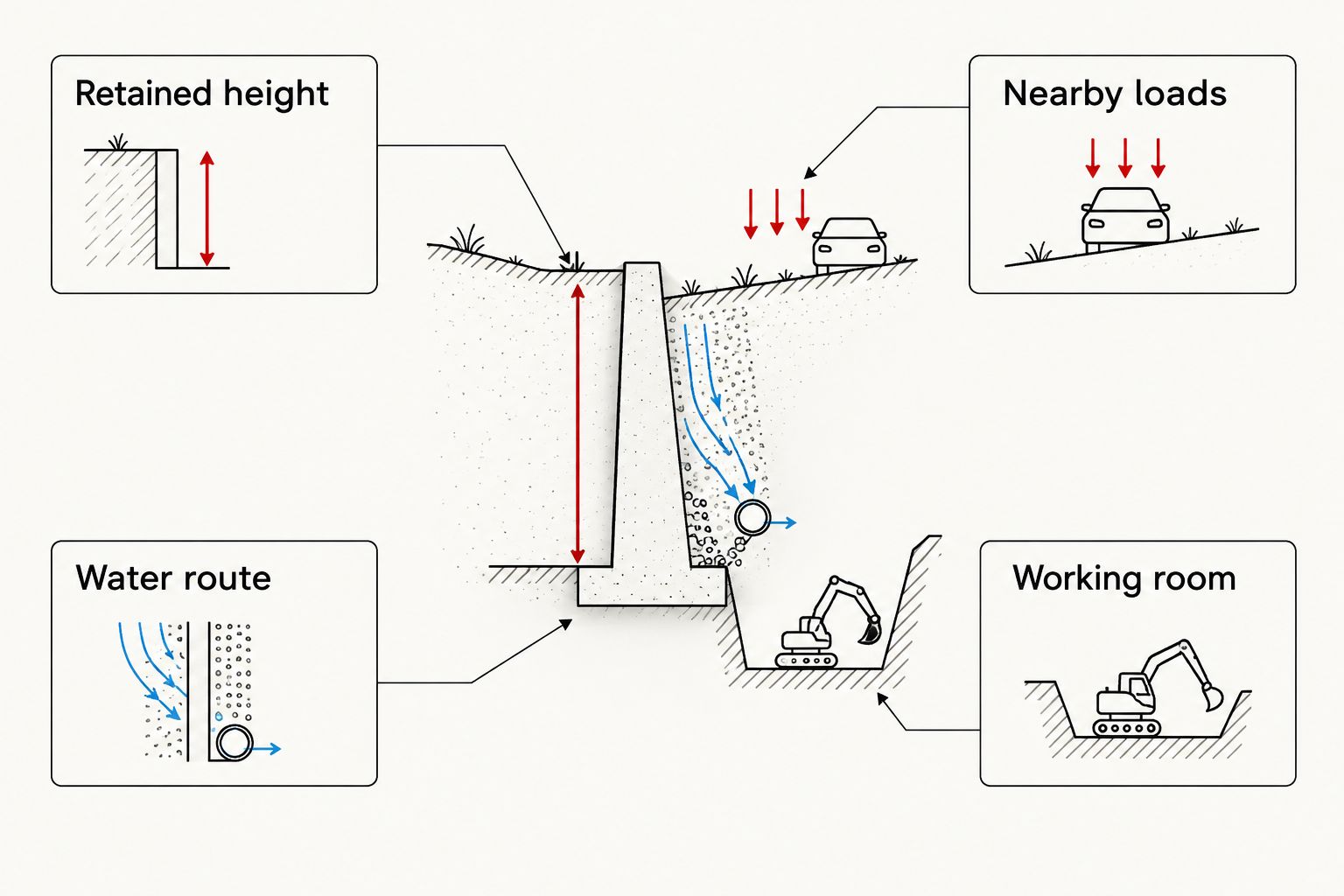
A material shortlist is useful only after you understand the ground it will retain. Before requesting a construction proposal, walk the site and record these details:
- Retained height: Measure the grade change, including portions of the wall that will sit below finished ground.
- Water route: Identify where runoff arrives and where collected water can discharge.
- Nearby loads: Mark driveways, buildings, fences, and slopes above the wall.
- Working room: Check excavation space, access, utilities, and property boundaries.
For a 2026 project, confirm current requirements with your local building authority before buying materials. Permit rules and engineering requirements depend on the jurisdiction and site conditions; an internet height rule is not approval to build.
Keep planting decisions connected to the wall plan. Tree roots, irrigation, and future access all deserve attention before the beds are finished.
How the materials rank
This ranking prioritizes structural fit, drainage compatibility, outdoor exposure, repair needs, and residential yard space. It compares construction types, not tested brands or individual products.
Segmental concrete block takes the default position because a coordinated system suits many residential layouts. Natural stone and boulders win distinct appearance-led use cases; poured concrete and gabions need a clearer site-specific reason. Timber stays in the garden-edge category.
Which retaining wall material should you choose?
Choose segmental concrete block unless your site or landscape design gives you a clear reason to choose something else. Then confirm that the proposed system, foundation, reinforcement, and drainage match the actual ground conditions.
Grassgrabbers serves central Iowa homeowners with lawn care and landscaping. For a Grassgrabbers landscaping plan in 2026, treat retaining wall material selection as part of the wider yard layout—not a color decision made before checking water and grade.
FAQ
What's the best retaining wall material for an Iowa yard?
Segmental concrete block is the best default choice for many Iowa residential retaining walls. Choose a coordinated system and confirm that its foundation, drainage, and reinforcement suit the site.
Is natural stone better than concrete block for a retaining wall?
Natural stone is better for a varied, traditional finish; concrete block is better when you want manufactured units within a coordinated wall system. Neither material compensates for unsuitable drainage or construction.
Can I use landscape timber to hold back a slope?
Landscape timber is not the default recommendation for substantial soil retention. Its strongest use in this comparison is small, nonstructural garden edging where future replacement remains practical.
Do gabion walls still need drainage planning?
Yes, gabion walls still need drainage and soil-filtration planning. A permeable basket face does not prevent retained soil from washing out or establish a safe discharge route by itself.
Do I need a permit for a retaining wall in Iowa?
Permit requirements depend on your local jurisdiction and site conditions. Ask the local building authority about the proposed wall height, nearby loads, and engineering requirements before construction.
Are boulders a good choice for a narrow side yard?
Boulders are generally a poor starting choice for a narrow side yard because their footprint and installation access need room. Compare a designed wall system against the available space before selecting a material.
What should I ask before approving a retaining wall proposal?
Ask for the material system, foundation detail, drainage route, reinforcement requirements, and excavation footprint. Confirm permits and engineering responsibilities before accepting the construction scope.
One last thing
Ask where the water goes after it leaves the wall. A drain without a suitable outlet leaves a central problem unresolved. For Grassgrabbers landscaping customers, that question belongs alongside mowing access, planting space, and the finished look of the yard.