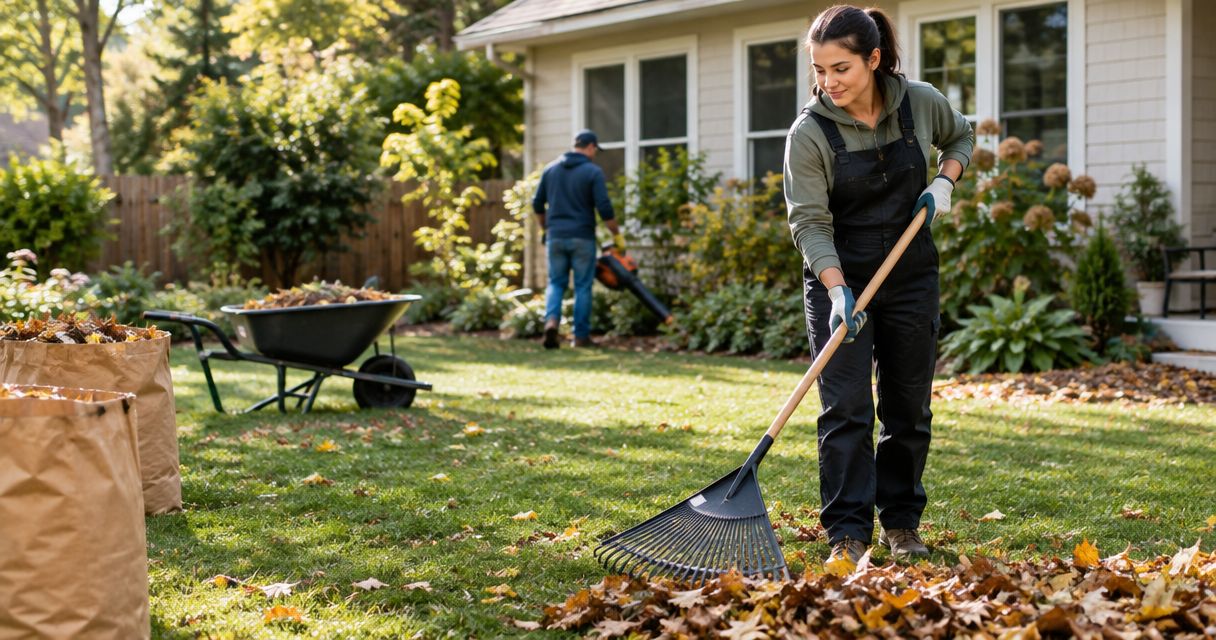
A full yard cleanup takes as long as the agreed work requires: the area being cleared, debris volume, bed work, access, and disposal all affect the completion window. For your 2026 cleanup, ask for an estimate that includes loading and final cleanup—not just the time spent collecting leaves.
- How long does yard cleanup take? Define the work, debris removal, and access before accepting a completion estimate.
- Grassgrabbers provides lawn care and landscaping services for residential property owners in central Iowa.
- Compare cleanup estimates by included tasks, crew size, and disposal—not elapsed time alone.
- Keep tree work, drainage repairs, and new landscaping separate from the basic cleanup scope.
Why this matters
A yard can look finished while bags, branches, and leaf piles still need moving. That difference matters when you need the driveway clear, the gate secured, or the property ready for visitors.
A useful cleanup estimate describes the finished result, not just an arrival time. Grassgrabbers lawn care and landscaping services serve residential property owners in central Iowa. You can start a conversation about your property through Grassgrabbers, with photos and a clear list of the work you want completed.
Before scheduling, decide whether you want loose debris removed or a broader reset that includes beds, edges, and other agreed maintenance. Those are different jobs, even when they cover the same yard.
How long does a full yard cleanup take?
A full yard cleanup has no single duration that applies to every property. The useful answer is a property-specific completion window tied to a written task list, the crew assigned, and the destination for collected material.
The word full needs explaining. One homeowner means leaves removed from the lawn; another means leaves, fallen branches, beds, mowing, and all debris taken away. Neither description tells you the time until someone checks the amount and condition of the work.
Use this comparison to make sure you are asking for the right scope:
| Cleanup scope | Best for | Work to confirm | Scheduling limitation |
|---|---|---|---|
| Lawn debris cleanup | Homeowners focused on clearing open grass | Leaves, loose twigs, collection, and disposal | Does not automatically include beds or pruning |
| Lawn and bed cleanup | Homeowners wanting grass and planted areas tidied | Lawn debris plus agreed work around plants and bed edges | Detailed work around plants adds tasks beyond open-lawn collection |
| Overgrown-yard cleanup | Homeowners dealing with accumulated growth and debris | Vegetation to remove, items to retain, and debris handling | Hidden obstacles and unclear plant boundaries complicate the scope |
| Cleanup with additional landscaping | Homeowners combining tidying with property changes | Separate lists for cleanup and installation or repair | A landscaping project should not inherit a basic cleanup time estimate |
For a seasonal task checklist, see what is included in a fall yard cleanup. Use the checklist to mark what belongs in your job rather than assuming every task is included.
Lawn debris cleanup: confirm the disposal endpoint
Best for: a yard where the main problem is loose material on the lawn. This scope keeps the work focused and makes the finish easier to describe: clear the agreed lawn areas and handle the collected debris as specified.
The advantage is a narrow task list. The limitation is that a clear lawn does not mean the planting beds, fence line, or shrub interiors have been cleaned.
Tell the provider where leaves collect, whether branches are mixed in, and whether debris should stay on the property. A designated compost area is a different destination from a trailer that must leave the site. Neither should be assumed.
For a 2026 appointment, describe current conditions rather than relying on an old photo. A recent leaf drop or a new branch pile changes the work being estimated.
Lawn and bed cleanup: identify what stays
Best for: a yard that needs attention around established plantings as well as open grass. Bed cleanup requires decisions about plants, not just debris collection.
The benefit is a more clearly defined finish across the yard. The limitation is that indiscriminate clearing can remove material or growth you intended to keep.
Walk through the beds before work begins. Identify desirable seedlings, bulbs, dormant plants, and any areas you want left undisturbed. Do not treat every standing stem or patch of leaf litter as unwanted material.
Specify whether edging, cutting back plants, and weed removal belong in the job. Those tasks are not interchangeable, and a request to “tidy the beds” leaves too much open to interpretation.
Overgrown-yard cleanup: separate clearing from restoration
Best for: a property where accumulated growth makes routine maintenance difficult. The first useful decision is what needs clearing and what needs protecting.
The advantage of a defined clearing phase is that it makes the property easier to assess. The limitation is that removing overgrowth does not repair bare soil, drainage problems, damaged edging, or worn lawn areas.
Mark obstacles before work starts, including loose wire, edging, irrigation components, and objects concealed by vegetation. Keep suspected hazardous waste out of an ordinary yard-debris pile and discuss it separately.
If you want new planting or lawn repair afterward, ask for that work as a separate scope. For 2026 planning, distinguish “ready for the next project” from “the entire landscape is restored.” They are different finish lines.
Why yard cleanup time varies
The same lot size can produce very different cleanup jobs. These factors explain what your completion estimate needs to account for:
- Area being cleared: Identify the actual work zones, including side yards, beds, and fence lines. Lot size alone does not describe them.
- Debris volume and condition: A scattered layer of dry leaves is different to handle from compacted, wet material mixed with branches.
- Detail work: Clearing around plants, furniture, edging, and narrow corners requires different handling from collecting debris on open grass.
- Access and carrying distance: Gates, steps, slopes, and the route to the loading area affect how material moves through the property.
- Crew and equipment: Ask who is assigned and whether the planned equipment can reach the work areas. Do not compare elapsed time without that context.
- Disposal arrangements: Gathering, bagging, loading, transporting, and sweeping up are distinct tasks. Confirm which ones the estimate covers.
Weather also affects whether the planned work can proceed without creating problems. If the ground is soft or material is saturated, discuss the work plan before equipment enters the yard.
Ask what conditions would change the estimate. That answer is more useful than a firm-sounding time promise with no explanation behind it.
How to get a useful completion estimate
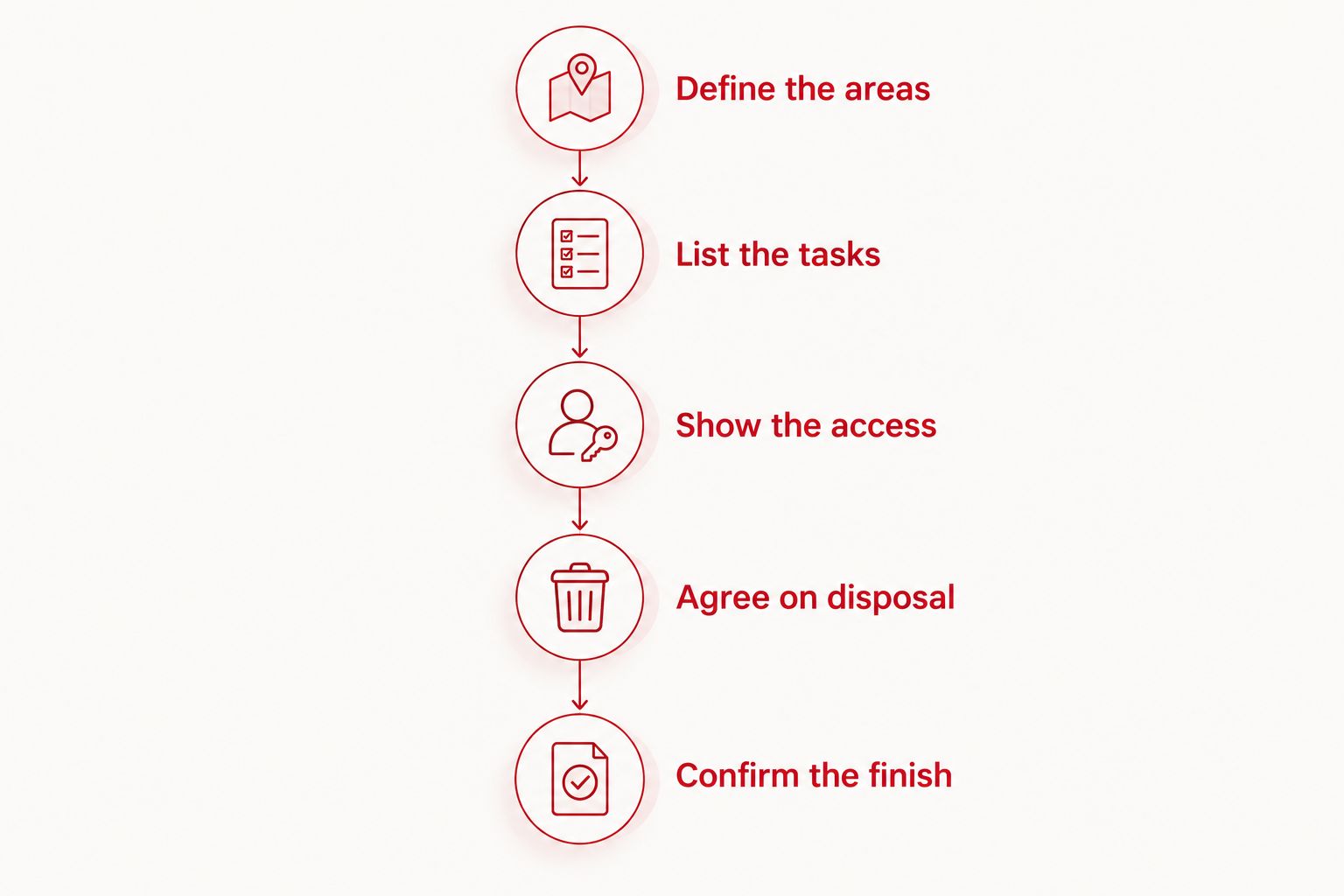
A clear walkthrough gives both you and the provider the same finish line. For your 2026 cleanup, use this sequence before agreeing to an arrival window or arranging access.
- Define the areas. Name the front lawn, back lawn, beds, fence line, and any excluded spaces. Show the boundaries in photos or during a walkthrough.
- List the tasks. Separate leaf collection, branch pickup, bed work, mowing, and other requested maintenance. Identify anything that needs a separate assessment.
- Show the access. Point out gates, steps, parking restrictions, and the loading route. Mention pets and explain how the yard should be secured afterward.
- Agree on disposal. State whether debris stays in a designated location or leaves the property. Confirm who handles containers and loading.
- Confirm the finish. Ask what will be complete before departure, what would trigger a change, and how changes will be approved.
Take photos that show the whole work area as well as problem spots. A close-up of a leaf pile does not show the distance to the gate or the beds behind it.
Grassgrabbers lawn care is best for central Iowa homeowners seeking help with lawn and yard maintenance. For any service provider, including Grassgrabbers, confirm the exact cleanup tasks and completion window before scheduling; the service category alone does not define the job.
Discuss your yard cleanup
Bring your task list, property photos, and disposal preferences to the conversation.
How can you help cleanup work stay on track?
Prepare the property without changing the job into something different. Put away toys, pet bowls, hoses, and movable furniture in the agreed work areas. Pick up pet waste and identify anything fragile or difficult to see.
Leave access instructions that match the actual appointment. An unlocked gate helps only if the route beyond it is clear and the crew knows which areas are included.
Do not hide problem material inside leaf piles. Wire, sharp objects, and household rubbish need identifying before someone handles the debris.
Keep your phone available for scope questions. If additional work appears, approve the change explicitly rather than assuming it fits the original completion window. A clear decision prevents an unfinished expectation at the end of the visit.
Should you clean the yard yourself or hire help?
Choose based on the work, your equipment, and your ability to handle the debris safely—not on an unsupported promise that either approach will be quick.
| Approach | Best for | Main benefit | Main limitation |
|---|---|---|---|
| Do it yourself | Homeowners comfortable with the defined tasks and debris handling | You control the sequence and what stays | You supply the labor, equipment, and disposal arrangements |
| Hire yard maintenance help | Homeowners who want someone else to carry out an agreed scope | You can assign collection and other specified tasks together | You still need to confirm inclusions, access, and the finished result |
| Split the work | Homeowners who want help with selected tasks | You can reserve manageable work for yourself | Unclear handoffs leave tasks or debris between responsibilities |
For a split job, write down the handoff. “I will clear the beds; you will collect and remove the lawn debris” is clearer than “I will do some preparation.”
Do not attempt unfamiliar tree work or handle unidentified hazardous material merely to keep a cleanup on schedule. Separate those problems from ordinary yard maintenance.
Will the cleanup be finished before I need to use the yard?
Ask for a completion window tied to your deadline and the agreed scope. Explain whether you need the lawn usable, the driveway clear, or all debris removed; those requirements describe different endpoints.
Does a larger crew always finish sooner?
A larger crew does not guarantee an earlier finish because access, equipment, loading, and task dependencies still matter. Ask about expected elapsed time for the assigned crew, rather than trying to calculate it from headcount alone.
FAQ
How long does yard cleanup take if my yard is small?
A small yard still needs a scope-based completion estimate. Debris volume, detailed bed work, access, and disposal can matter as much as the area being cleared.
Can a full yard cleanup be completed in one visit?
Confirm whether the entire agreed scope is scheduled for one visit. Separate landscaping work, disposal arrangements, or unsuitable ground conditions can change how the job is scheduled.
Does a full yard cleanup include hauling everything away?
Hauling is included only when the agreed scope says collected material will leave the property. Confirm loading, transport, and the destination before work starts.
Should I be home during the yard cleanup?
Ask the provider whether you need to be home for access or decisions. If you will be away, agree on boundaries, gate instructions, pet arrangements, and how scope changes will be approved.
Is mowing included in a full yard cleanup?
Mowing is included only if it appears in the agreed task list. Leaf collection, bed cleanup, mowing, and edging should each be named rather than assumed.
Can I get an accurate cleanup estimate from photos?
Photos help describe the work, but they need to show access, boundaries, and debris conditions as well as close-ups. Ask whether a walkthrough is needed before relying on the completion window.
Does Grassgrabbers provide yard maintenance in central Iowa?
Grassgrabbers provides lawn care, landscaping, and yard maintenance services for residential property owners in central Iowa. Discuss the specific cleanup tasks and property conditions before agreeing to a schedule.
One last thing
Before booking your 2026 yard cleanup, ask: What will still be on my property when the work is finished? That question catches a common gap between “collected” and “removed.”
Then describe the result you want in plain language: lawn cleared, selected beds tidied, agreed debris removed, and access secured. A shared finish line makes the time estimate useful.