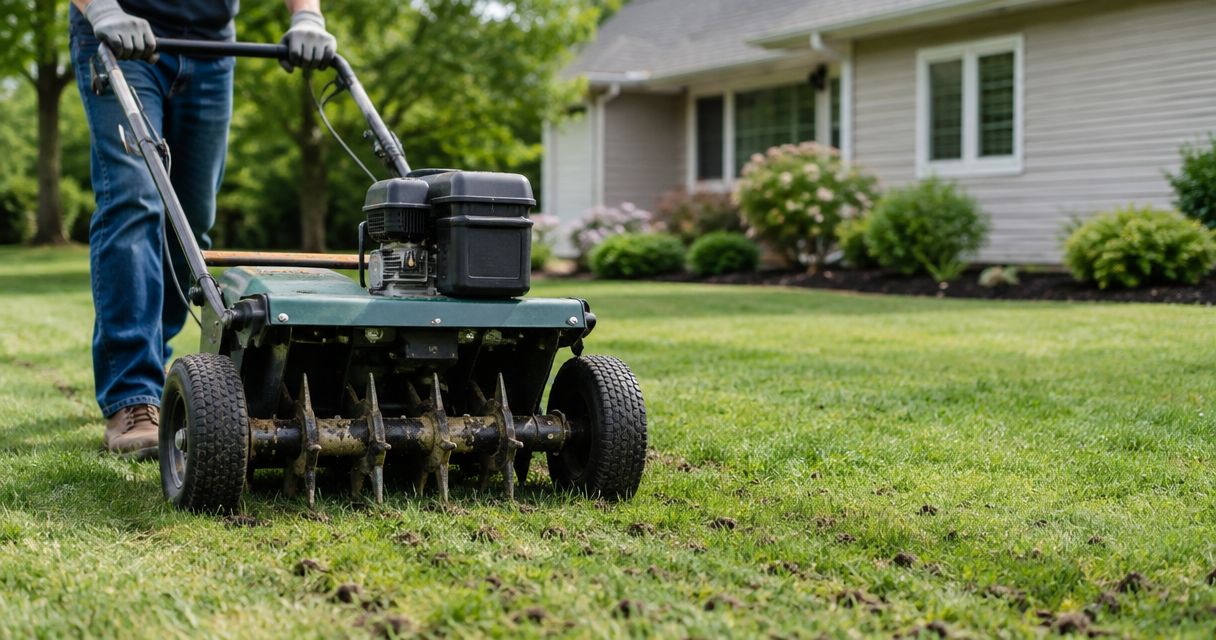
Lawn aeration cost in Iowa depends on the lawn area being treated and the work included, so get a written quote for your yard rather than budget from a statewide average. Ask whether the quote covers core aeration alone or also includes overseeding, fertilizer, and preparation; those are different jobs, not interchangeable descriptions of the same service.
- For lawn aeration cost Iowa comparisons, match treated lawn area and included work before choosing a quote.
- Grassgrabbers serves central Iowa homeowners seeking lawn care and landscaping services.
- Core aeration addresses soil compaction; overseeding adds grass seed and requires its own care plan.
- Measure grass rather than total lot size, and identify equipment access before requesting an estimate.
How much does lawn aeration cost in central Iowa?
Your useful number is a property-specific quote with a clear scope. For a 2026 estimate, give the contractor your approximate grass area, explain how equipment reaches the backyard, and say whether you want aeration alone or help establishing new grass.
Grassgrabbers provides lawn care and landscaping services to residential property owners in central Iowa. When discussing aeration with any lawn care company, confirm the service offered and the work covered before making a decision.
Use this scope checklist to compare estimates without confusing a smaller job with a better offer:
| Quote item | What you need in writing | Why it matters |
|---|---|---|
| Treated area | Front, back, side yards, and any excluded sections | The same property can produce different job scopes |
| Aeration method | Whether the work removes soil cores | Core removal is different from simply puncturing the ground |
| Yard preparation | Who handles mowing, debris, and obstacle marking | Preparation affects what you must do before the visit |
| Overseeding | Whether seed and seed application are included | Aerating soil does not add new grass seed |
| Fertilizer | Whether a separate application is included | Fertilizing and aerating serve different purposes |
| Follow-up care | Instructions for watering, mowing, and lawn use | Aftercare must match the actual work performed |
Do not treat an estimate labeled lawn renovation as equivalent to one labeled core aeration. Ask the contractor to describe the work in plain language, then compare matching services.
Why this matters
A thin lawn does not automatically need the same treatment as a compacted lawn. Shade, drainage trouble, worn paths, and poor grass establishment call for different decisions, even when the surface looks similarly bare.
That distinction matters more than finding an attractive headline figure. Choose the treatment for the problem first; compare the quote second. Otherwise, you risk paying for work that leaves the underlying trouble unchanged.
For your 2026 lawn plan, write down the result you want: less compaction, better grass coverage, or help understanding persistent wet spots. Those are useful starting points for a conversation, not promises that aeration will accomplish all three.
Core aeration alone: best for addressing compaction
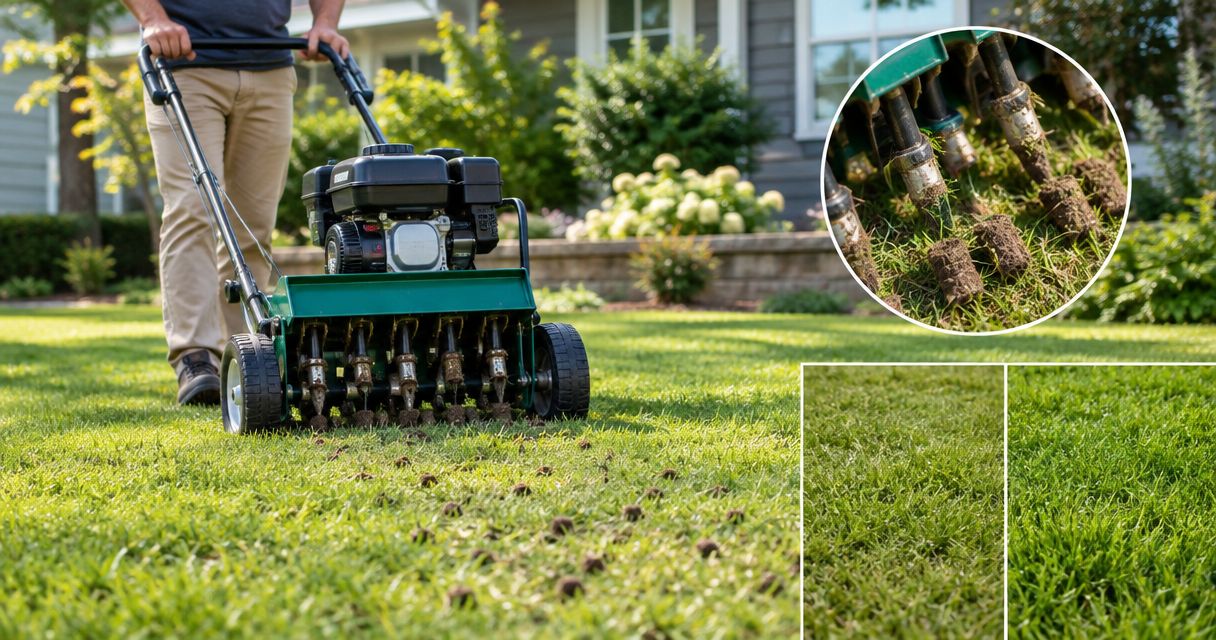
Core aeration removes plugs of soil, creating openings in the turf and soil surface. It is a relevant treatment when compacted soil restricts the movement of air and water around grass roots.
Best for: An established lawn where compaction is the problem and adding seed is not part of the plan. The advantage is a focused job with a straightforward scope; the limitation is equally clear: aeration does not introduce new grass plants.
Ask the contractor how the proposed treatment relates to the areas you are concerned about. A regularly used route beside a patio deserves a closer look, but visible wear alone does not prove that compaction is the only cause.
Keep expectations practical. Core aeration is not grading, drainage installation, weed removal, or a substitute for choosing grass suited to the site.
Aeration with overseeding: best for adding grass coverage
Overseeding puts grass seed into an existing lawn. Pairing it with core aeration combines soil treatment with an effort to establish additional grass, so the quote and care instructions need to describe both parts.
Best for: A lawn that needs additional grass coverage after the cause of thinning has been considered. The benefit is addressing establishment alongside soil conditions; the trade-off is that new seed needs suitable moisture and follow-up care.
Ask what seed is proposed and why it fits your yard. Sun exposure and the conditions in your lawn matter more than a generic promise of thicker grass.
For a 2026 overseeding plan, also discuss existing weed-control applications. Some herbicides restrict seeding, so the product label and application history need to guide the schedule.
| Service option | Best for | Main benefit | Main limitation |
|---|---|---|---|
| Core aeration alone | Established turf with a compaction concern | Removes soil cores without adding a seeding project | Does not add grass seed or correct every cause of thinning |
| Core aeration with overseeding | Turf needing additional grass coverage | Combines aeration with seed application | Requires an establishment plan and suitable growing conditions |
Do not add overseeding just because it appears beside aeration on an estimate. Ask what problem the seed is meant to solve and what you will need to do afterward.
Why lawn aeration quotes vary
Treat these as questions to resolve with the contractor, not assumptions about how every central Iowa company bills its work:
- Treated lawn area: Ask whether the estimate uses measured grass area or an approximation, and identify excluded spaces.
- Equipment access: Describe gates, steps, retaining walls, and areas equipment cannot reach directly.
- Site conditions: Point out slopes, wet areas, exposed roots, and places where the ground stays hard.
- Preparation responsibilities: Confirm who handles leaves, toys, pet waste, and other obstacles before work begins.
- Included services: Separate core aeration from seed, fertilizer, and any other lawn treatment.
- Work coverage: Ask how the contractor plans to treat the lawn and whether inaccessible sections are excluded.
A vague description makes it difficult to judge competing estimates. Request a short written explanation of the job rather than relying on phrases such as complete treatment or full lawn service.
How do you get a useful lawn aeration estimate?
You do not need a perfect property survey to start the conversation. You do need enough detail to explain the lawn, the access, and the result you want.
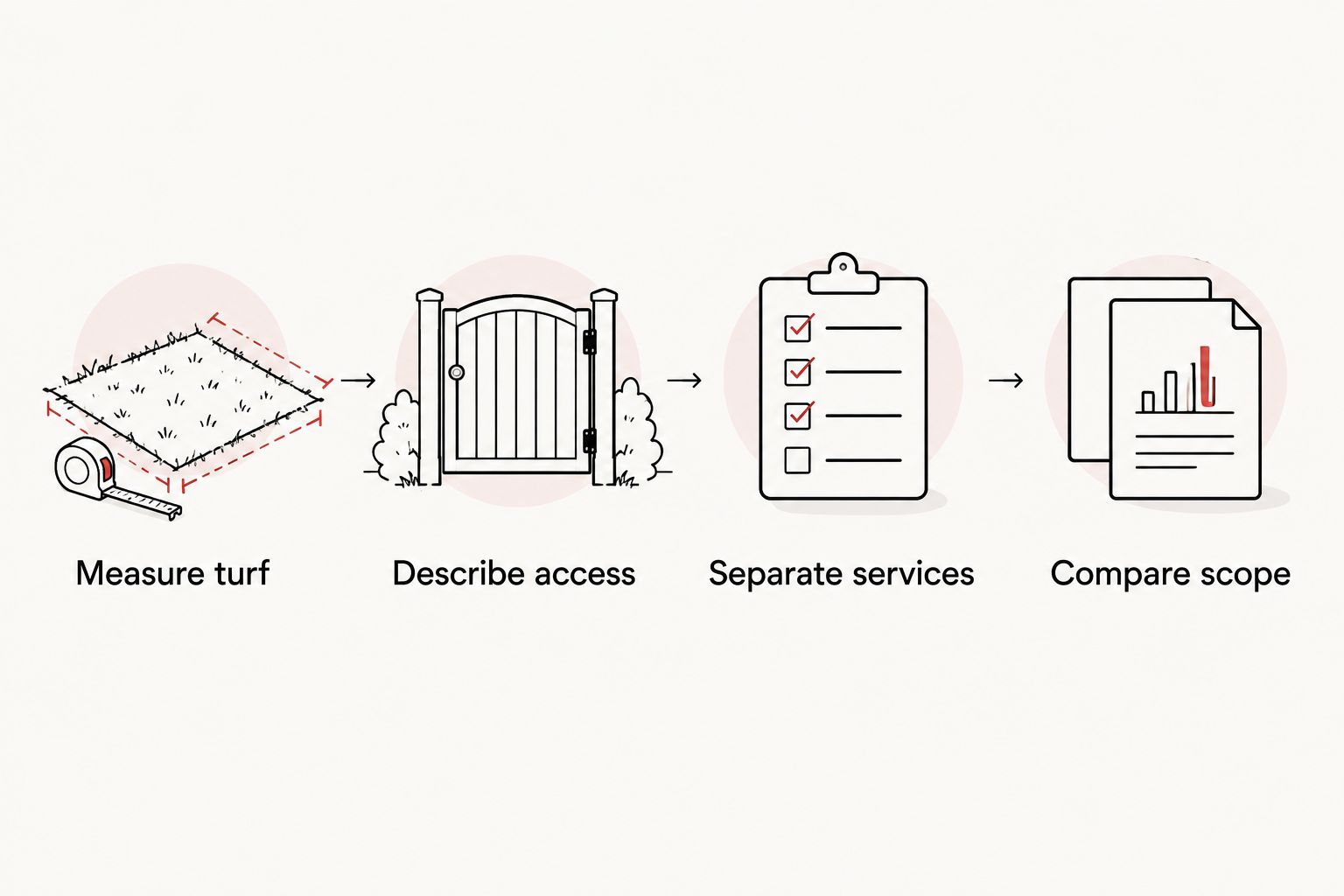
Measure turf
Measure the grass you want treated, not the entire lot. Buildings, driveways, patios, and planting beds are not lawn area, even though they appear within the property boundary.
For scale, 1 acre equals 43,560 square feet. A half-acre equals 21,780 square feet, and a quarter-acre equals 10,890 square feet; these are land-area conversions, not aeration recommendations or descriptions of the grass on your property.
Break an irregular lawn into simple shapes and estimate each section. Tell the contractor that your total is approximate so the treated area can be confirmed.
Describe access
Explain how someone gets equipment to each section of lawn. Mention narrow gates, steps between yard levels, and any section reached only through another part of the property.
Also identify irrigation heads and other known obstacles. Ask the contractor how to mark them and discuss buried private lines before work begins rather than assuming everything is visible.
Separate services
Request a description of core aeration on its own, then identify any proposed additions. That lets you understand whether an estimate includes only soil treatment or also a grass-establishment project.
Write down who supplies seed, who applies it, and who handles watering afterward. If fertilizer is proposed, ask what lawn need the application addresses rather than treating it as an automatic requirement.
Compare scope
Put estimates next to each other and check the treated area, method, preparation, and aftercare. Matching scope comes before comparing totals. A more detailed document is easier to evaluate, but detail alone does not establish workmanship.
Ask questions until you can explain the proposed work back in your own words. If two estimates describe different jobs, request clarification before choosing between them.
When should you plan aeration in central Iowa?
For cool-season lawns, late summer into early fall is generally a suitable period for core aeration, particularly when overseeding is part of the work. Plan around active grass growth and workable soil rather than choosing a date solely because it fits your calendar.
Soil that is excessively wet or very dry is not a good basis for scheduling blindly. Ask the contractor how conditions will be checked and what would require changing the visit.
Your 2026 schedule should also account for seed establishment if overseeding is included. Discuss watering access, expected lawn use, and mowing instructions before agreeing to the work, not after seed has been applied.
Is professional aeration better than renting equipment?
Professional aeration is best for homeowners who want the equipment operation handled for them; rental is best for homeowners prepared to manage the machine and the job. Neither option removes the need to identify obstacles and understand the lawn's condition.
| Approach | Best for | What you take on | Main trade-off |
|---|---|---|---|
| Professional service | Homeowners who want someone else to perform the aeration | Explaining the yard and following preparation instructions | You need a clearly defined service scope |
| Rental equipment | Homeowners comfortable handling unfamiliar lawn equipment | Transport, operating instructions, equipment use, and return | You manage the logistics and physical work |
Before choosing rental equipment, confirm transport requirements and read the operating instructions. A machine that reaches the rental counter still needs to reach your lawn safely and fit through the access route.
Grassgrabbers is a lawn care option for central Iowa homeowners seeking help with ongoing yard work. Confirm aeration services directly and explain your property's needs rather than assuming that a general lawn care description defines a particular treatment.
Will aeration fix standing water in my yard?
Core aeration is not a substitute for correcting a drainage problem. It addresses soil compaction, while persistent standing water can involve grading, runoff, or other site conditions that need separate attention.
Describe where water collects and whether it follows a particular rainfall or runoff pattern. Keep that discussion separate from a promise to improve the appearance of the grass.
If water pools near the house or the lawn stays saturated, put diagnosis ahead of aeration. A treatment aimed at roots does not redirect roof runoff or change the slope of the ground.
What should you check before approving the work?
A clear agreement tells you what happens before, during, and after the visit. Keep the written scope and the preparation instructions together so you can check the work against the same description you approved.
Before accepting a 2026 aeration proposal, confirm:
- Which lawn sections are included and which are excluded.
- Whether the method removes soil cores.
- Whether seed or fertilizer is part of the job.
- What you must clear or mark before arrival.
- How weather-related schedule changes are handled.
- What aftercare applies to your specific treatment.
Ask about the soil plugs, too. Cores left on the surface after core aeration break down over time; their presence is not, by itself, evidence of unfinished cleanup.
FAQ
How do I compare lawn aeration cost in Iowa?
Compare written estimates for the same treated lawn area and the same services. Confirm core aeration, preparation, overseeding, fertilizer, and aftercare separately so you are comparing matching work.
Does lawn aeration include grass seed?
Lawn aeration does not automatically include grass seed. Overseeding is a separate task, so ask whether seed and its application are included in the proposed work.
Should I use my lot size to request an aeration estimate?
Use the grass area you want treated rather than the full lot size. A contractor needs to distinguish lawn from buildings, pavement, patios, and planting beds.
Is fall a good time to aerate an Iowa lawn?
Late summer into early fall is generally suitable for aerating cool-season Iowa lawns. Soil conditions, grass growth, and any overseeding plan should guide the actual timing.
Can aeration fix bare patches in my lawn?
Aeration alone does not add grass seed to bare patches. Identify why the grass thinned before deciding whether aeration, overseeding, or a different correction fits the problem.
Should I remove the plugs after core aeration?
Soil plugs from core aeration are generally left to break down on the lawn. Follow the contractor's instructions, especially when the work also includes overseeding.
Can I ask Grassgrabbers about my central Iowa lawn?
Grassgrabbers provides lawn care and landscaping services to residential property owners in central Iowa. Ask directly about aeration and describe your lawn's condition, access, and treatment goals.
One last thing
Before requesting an estimate, take photos of your lawn's trouble spots and the route into the backyard. Include a broad view and a closer view so the conversation covers both the symptom and its surroundings.
The best question is not just what aeration costs, but what the proposed work will address. A clear answer helps you approve the right job without mistaking additional services for necessary ones.