HOA community lawn care is the upkeep of shared grass and landscaped areas with the aim of keeping neighborhood grounds safe, usable, and consistent. This 2026 guide explains how your board can define responsibilities, compare maintenance options, and check the work without turning every lawn complaint into a board meeting.
- Lawn care for HOA communities starts with a written boundary between association grounds and homeowner responsibilities.
- Grassgrabbers is best suited to central Iowa homeowners seeking residential lawn care and landscaping; confirm shared-area scope separately.
- Compare HOA maintenance proposals against the same map, service standards, and exclusions—not a mowing description alone.
- Keep drainage, turf recovery, and resident communication in the plan alongside routine mowing.
Why lawn care matters for HOA communities
An HOA lawn is shared space with shared decisions behind it. Your board needs to maintain the property while explaining what association dues cover, where homeowner responsibility begins, and how service problems get resolved.
A single-family homeowner can change a mowing plan without consulting neighbors. An association needs a repeatable standard that survives resident complaints, contractor changes, and board turnover. The first job is defining responsibility, not choosing a mower.
For individual properties, Grassgrabbers provides residential lawn care, landscaping, and yard maintenance in central Iowa. Association boards should confirm whether a proposed engagement covers common grounds rather than assuming residential service includes HOA-wide management.
Grassgrabbers is best suited to central Iowa homeowners seeking residential lawn care and landscaping. That distinction matters when your association maintains shared entrances but residents maintain their own yards.
For your 2026 plan, separate routine appearance work from repairs and improvements. Mowing an entrance, correcting standing water, and renovating bare turf are different jobs. They need different approval rules and written scopes.
Build an HOA lawn care plan your board can manage
Start with a shared document and a property walk. You do not need special software to identify who owns each task, record trouble spots, and compare proposals fairly.
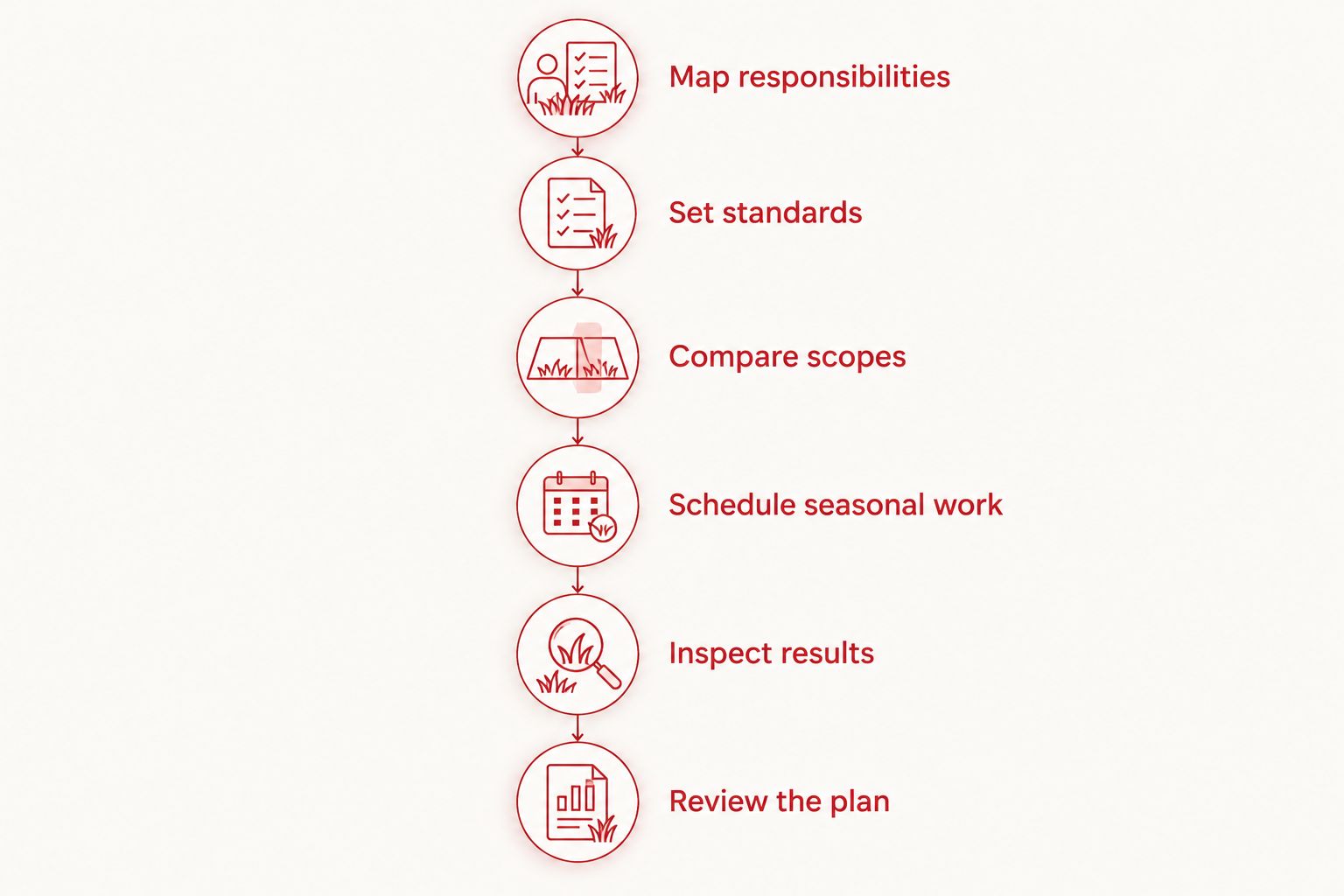
Follow this sequence: map responsibilities, set standards, compare scopes, schedule seasonal work, inspect results, and review the plan. Keep the same document available to the board, property manager, and whoever performs the work.
Map responsibilities
Walk the neighborhood with an existing property map and mark every maintained area. Check governing documents and recorded boundaries before assigning responsibility; the grass beside a sidewalk does not automatically belong to the association.
Create 1 marked property map that distinguishes common grounds, homeowner-maintained lawns, and areas needing clarification. Include entrance islands, drainage features, mailbox areas, slopes, and strips behind fences. These small spaces are easy to miss in a general mowing proposal.
Record access restrictions as well. A gate, parked vehicle, or narrow passage can change how a crew reaches the work. Resolve uncertain boundaries before asking anyone to quote them.
- Mark association-maintained turf and planting beds.
- Identify homeowner-maintained areas separately.
- Flag easements and boundaries needing document review.
- Note gates, slopes, utilities, and restricted access.
- Photograph recurring wet spots and damaged edges.
Set standards
Write down what acceptable work looks like before comparing providers. A simple checklist works: grass cut appropriately, hard surfaces cleared of clippings, visible damage reported, and missed areas documented.
Avoid treating one mowing height as a rule for every patch of ground. Grass type, shade, weather, and site conditions affect maintenance decisions. Identify the turf before specifying its care; do not force a sunny entrance and a shaded courtyard into identical instructions.
Separate appearance complaints from plant-health problems. Thin grass beneath trees needs a different response from a missed mowing pass. The guide to shade-tolerant grass seed for Iowa lawns explains an issue to investigate before repeatedly reseeding the same spot.
- Describe mowing, trimming, and cleanup expectations separately.
- Identify turf types before setting mowing instructions.
- Require reporting of mower damage and irrigation damage.
- Define how crews handle wet ground and blocked access.
- Record where clippings and collected debris belong.
Compare scopes
Build your own checklist first, then ask providers to respond to it. Request 3 comparable proposals when practical, using the same map and task list for each. A proposal with fewer tasks is not equivalent to one that includes beds, cleanup, and turf repair.
Ask Grassgrabbers about residential lawn care and landscaping needs where those services match your property responsibilities. For association-owned grounds, confirm service boundaries, scheduling, reporting, and exclusions before treating any provider as an HOA maintenance partner.
Your 2026 scope should distinguish routine visits from separately approved work. Fertilizer applications, weed treatment, aeration, seeding, pruning, and drainage corrections should not disappear inside a vague promise to maintain the landscape.
- Send every bidder the same map and checklist.
- Request an explicit list of included tasks.
- Ask which tasks require separate authorization.
- Confirm insurance documentation and applicable credentials.
- Identify who receives service requests and approves changes.
- Record weather-delay and missed-visit procedures.
Schedule seasonal work
Start with a calendar your board can edit rather than a rigid schedule copied from another property. Put routine maintenance, turf assessments, leaf cleanup, and board approvals in separate entries. Adjust fieldwork to actual ground and growing conditions.
In central Iowa, cool-season lawn care must account for summer stress and fall recovery. Iowa State University Extension and Outreach identifies late summer and early fall as favorable periods for establishing cool-season lawns. Use that established seasonal guidance, then match the work to the site and current conditions.
For 2026, schedule decisions before the work needs approval. A board that first discusses bare turf after its intended renovation window has already limited its choices. Ask a qualified provider to distinguish turf damage from dormancy before ordering corrective work.
- Mark seasonal inspections before authorizing treatments.
- Coordinate mowing with seeding and repair areas.
- Keep equipment off saturated, easily rutted ground.
- Plan leaf removal around actual accumulation.
- Assign watering responsibility for newly seeded areas.
- Document weather-related changes to planned work.
Inspect results
Use a phone camera and the original checklist to inspect the same locations after service. Check entrances, narrow strips, fence lines, and beds—not just the largest open lawn. A consistent route makes inspection easier to repeat when board members change.
Set a 30-day review point after a new agreement begins. This is a board-management recommendation, not a promise that turf will recover within that period. Review whether the agreed work happened and whether communication worked.
Record the location, date, and requested correction for each issue. One shared log is more useful than competing text threads. Give the provider a clear report rather than forwarding a collection of conflicting resident instructions.
- Photograph the same inspection locations consistently.
- Check trimming, cleanup, missed areas, and damage.
- Separate new problems from previously recorded conditions.
- Send one consolidated correction request.
- Record the response and whether the issue was resolved.
Review the plan
Review the work log before renewing or expanding service. Look for repeated problems tied to site conditions, unclear instructions, or missing tasks. Changing providers will not fix a scope that leaves the same area unassigned.
Keep a short handover file for the next board: the marked map, current scope, unresolved issues, and approval contacts. Resident expectations should remain understandable after an election or management change.
Use your 2026 review to decide what belongs in routine maintenance and what needs a separate project. A chronically wet lawn, damaged grade, or deeply shaded area deserves diagnosis rather than another automatic treatment.
- Compare completed work with the agreed scope.
- Identify repeated complaints by location and cause.
- Record repairs that need separate investigation.
- Update responsibility boundaries after approved changes.
- Save the current plan for the next board.
Compare maintenance options for your community
No maintenance arrangement fits every association. Choose based on the work your governing documents assign, the site conditions, and the time someone can reliably spend coordinating service.
A 2026 comparison should consider accountability as well as who operates the equipment. An option is only workable when someone owns scheduling, inspection, and follow-up.
| Option | Best for | Practical advantage | Key limitation |
|---|---|---|---|
| Board-organized volunteer care | Limited shared areas with willing, capable volunteers | Direct control over priorities | Participation, equipment, and continuity need active coordination |
| Dedicated mowing contractor | Associations needing a clearly bounded mowing scope | Straightforward routine task list | Turf repair, beds, and seasonal work need explicit inclusion or separate arrangements |
| Lawn and landscape provider | Communities coordinating turf, beds, and cleanup | Related tasks can sit within one agreed scope | A broad service description does not prove every task is included |
| Separate specialist providers | Properties with distinct drainage, tree, or turf problems | Each project can receive focused assessment | The board must coordinate responsibilities and overlapping work |
| Homeowner-arranged residential service | Associations where governing documents leave individual yards to owners | Homeowners manage their own property needs | It does not replace maintenance of association-owned grounds |
Grassgrabbers provides residential lawn care, landscaping, and yard maintenance in central Iowa. That supports a conversation about individual yard needs; it does not establish an HOA-wide service scope. Ask for written confirmation of the actual work before making a recommendation to residents or the board.
Discuss your lawn care needs
Explain your property responsibilities and confirm which lawn care and landscaping tasks fit the scope.
Common mistakes HOA boards make
Treating every green space as association property
A visually continuous lawn can cross responsibility boundaries. Check the documents before instructing a crew to enter individual yards, and keep resident-requested extras separate from association-authorized work.
Comparing proposals with different task lists
A mowing-only proposal cannot answer the same need as a scope covering beds and seasonal cleanup. Compare exclusions line by line, then resolve gaps before approval rather than during a complaint.
Sending instructions through multiple board members
Conflicting directions make it difficult to determine what the provider was authorized to do. Designate 1 service contact and a backup, while keeping the board's approval rules intact.
Applying one treatment to every lawn problem
Standing water, shade, traffic, and weeds are different conditions. Record the symptoms and investigate the cause before repeating fertilizer, seed, or herbicide applications across the property.
Forgetting newly repaired areas
Seeding is not the end of a repair plan. Assign responsibility for watering, access restrictions, and follow-up inspection before approving the work, especially where residents or pets regularly cross the area.
FAQ
What's the best way to organize lawn care for an HOA community?
Start with a written responsibility map and a shared maintenance checklist. Use both to request comparable proposals, assign an approval contact, and inspect completed work.
Does the HOA have to maintain every lawn in the neighborhood?
HOA lawn maintenance responsibilities depend on the association's governing documents and property boundaries. Confirm those responsibilities before including individual yards in a maintenance agreement.
Is a mowing contractor enough for HOA grounds?
A mowing contractor fits an HOA whose agreed scope is limited to mowing and related cleanup. Beds, turf renovation, drainage problems, and seasonal work need explicit coverage or separate arrangements.
What should an HOA lawn care agreement include?
An HOA lawn care agreement should identify maintained areas, included tasks, exclusions, approval rules, and reporting procedures. It should also explain how weather delays, blocked access, damage, and missed work are handled.
How often should our HOA inspect lawn maintenance?
Inspect completed visits against the agreed checklist and review the arrangement after its first 30 days. Keep recurring inspection locations so different board members can compare the same areas.
Should an HOA require green grass throughout a dry summer?
An HOA should distinguish grass color from turf health before requiring corrective work. Assess grass type, moisture, site conditions, and signs of damage rather than using color alone as the maintenance standard.
Can homeowners hire their own lawn care provider?
Homeowners should check association rules and maintenance responsibilities before arranging service. Individual residential service does not transfer responsibility for common grounds or authorize changes to association-owned landscaping.
One last thing
Before renewing your 2026 agreement, walk the least visible part of the property—not the entrance. Check behind fences, beside drainage areas, and along narrow boundary strips.
An unassigned strip of grass is a responsibility problem before it is a mowing problem. Put it on the map, name the responsible party, and add the task to the correct scope. That small correction gives the next board something more useful than another unresolved complaint.