
Retirees’ low-maintenance lawn care is a simpler approach to mowing, planting, and yard upkeep with the aim of keeping an enjoyable yard without unnecessary physical work. This guide to low-maintenance lawn care for retirees focuses on central Iowa yards, where your plan should fit the work you want to do—not assume you want to give up gardening altogether.
- Low-maintenance lawn care for retirees starts by removing difficult chores, not replacing every planting bed.
- Grassgrabbers is best for central Iowa retirees seeking professional lawn care and yard maintenance rather than another DIY routine.
- Keep useful lawn, simplify awkward edges, and choose Iowa plants suited to the actual growing conditions.
- Compare doing everything yourself, sharing the work, and hiring recurring help before changing your yard.
Why lawn care matters for retirees
A retirement yard should leave room for sitting outside, growing favorite flowers, and enjoying the property. When mowing, dragging hoses, or hauling leaves takes over, the maintenance plan needs changing—not necessarily the whole landscape.
The goal for 2026 is fewer demanding tasks, not a yard with nothing growing in it. Start with the jobs you dislike or find difficult. Keep the parts that give you pleasure.
Plant selection is part of that decision, but it is not the whole answer. The guide to low-maintenance plants for Iowa yards helps you consider planting choices alongside mowing access, bed size, and watering needs.
Build a simpler lawn-care routine
1. Identify the chores you want to stop doing
Walk around your property before buying equipment or removing grass. Look at the route you take with the mower, where you carry supplies, and which beds require repeated bending. A neat-looking yard can still have a difficult maintenance routine.
Write down what each area asks of you. Separate enjoyable gardening from work you do only because it needs doing. Be specific: trimming behind the shed is a different problem from mowing an open front lawn.
For your 2026 plan, choose the most troublesome task first. Removing one recurring burden gives you a clearer starting point than trying to redesign everything at once. If a task involves poor footing or equipment you cannot control comfortably, leave it out of your DIY plan.
- Mark slopes, uneven ground, and awkward turns on a simple yard sketch.
- List jobs involving lifting, kneeling, reaching, or repeated carrying.
- Identify the flowers, trees, and lawn areas you want to keep.
- Separate routine chores from seasonal projects.
- Pick the first task to simplify or hand off.
2. Keep useful lawn and simplify awkward areas
An open patch of lawn can be easier to maintain than a collection of small beds. Do not remove grass simply because a planting is described as low maintenance. Establishing a new bed brings its own watering, weeding, and edging work.
Keep lawn where you use it or where mowing is straightforward. Review narrow strips, tight corners, and isolated ornaments that require extra trimming. Combining small planting areas can simplify the mowing route, provided the new bed remains manageable.
Choose fewer obstacles before choosing more plants. Avoid moving the workload from a mower to hand weeding. A large new garden is not a simpler yard if you do not want to maintain it.
- Keep open lawn where it serves a clear purpose.
- Remove unused objects that interrupt mowing routes.
- Combine small beds only when access and upkeep improve.
- Leave enough room to maintain both sides of a planting.
- Check mature plant width before placing anything beside a path.
3. Match mowing tasks to your comfort level
If you enjoy mowing and can handle the equipment comfortably, start with simple changes: clear the route, maintain the mower according to its manual, and avoid mowing wet grass. Never treat a difficult slope as a challenge you must finish yourself.
For established Kentucky bluegrass or tall fescue, a mowing height around 3–3.5 inches is a common extension recommendation. Follow guidance for your actual grass species and avoid removing more than 1/3 of the blade at a time. Taller growth does not mean you should cut it all back in one pass.
If mowing is the chore you want to stop, professional help is an alternative to buying different equipment. Grassgrabbers provides lawn care, landscaping, and yard maintenance for residential property owners in central Iowa. Grassgrabbers lawn care is best for retirees who want professional help with upkeep rather than responsibility for another machine.
Hiring help reduces your own physical work, but it still requires a clear agreement about scope and access. Discuss the areas you want maintained and the work you intend to keep doing yourself.
- Identify your grass before changing the cutting height.
- Follow the mower manual for operation and slope limits.
- Keep people and pets clear of the mowing area.
- Leave clippings on the lawn when they disperse without clumping.
- Ask a provider which mowing and trimming tasks are included.
4. Simplify beds without creating a weeding project
Start with the beds you already have. Remove unwanted growth, check plant spacing, and make the edges easier to follow. Retaining healthy, well-placed plants often makes more sense than replacing an entire bed.
An organic mulch layer around 2–3 inches deep is a common starting point for landscape beds. Account for mulch already present rather than adding that amount every season. Keep mulch away from trunks and plant crowns; a mound against a tree is not a useful shortcut.
A simpler bed has clear access and plants suited to its light, soil, and moisture. For your 2026 changes, tackle a manageable area before expanding the work across the property. Mulch helps with weed suppression and moisture conservation, but it does not remove the need to inspect the bed.
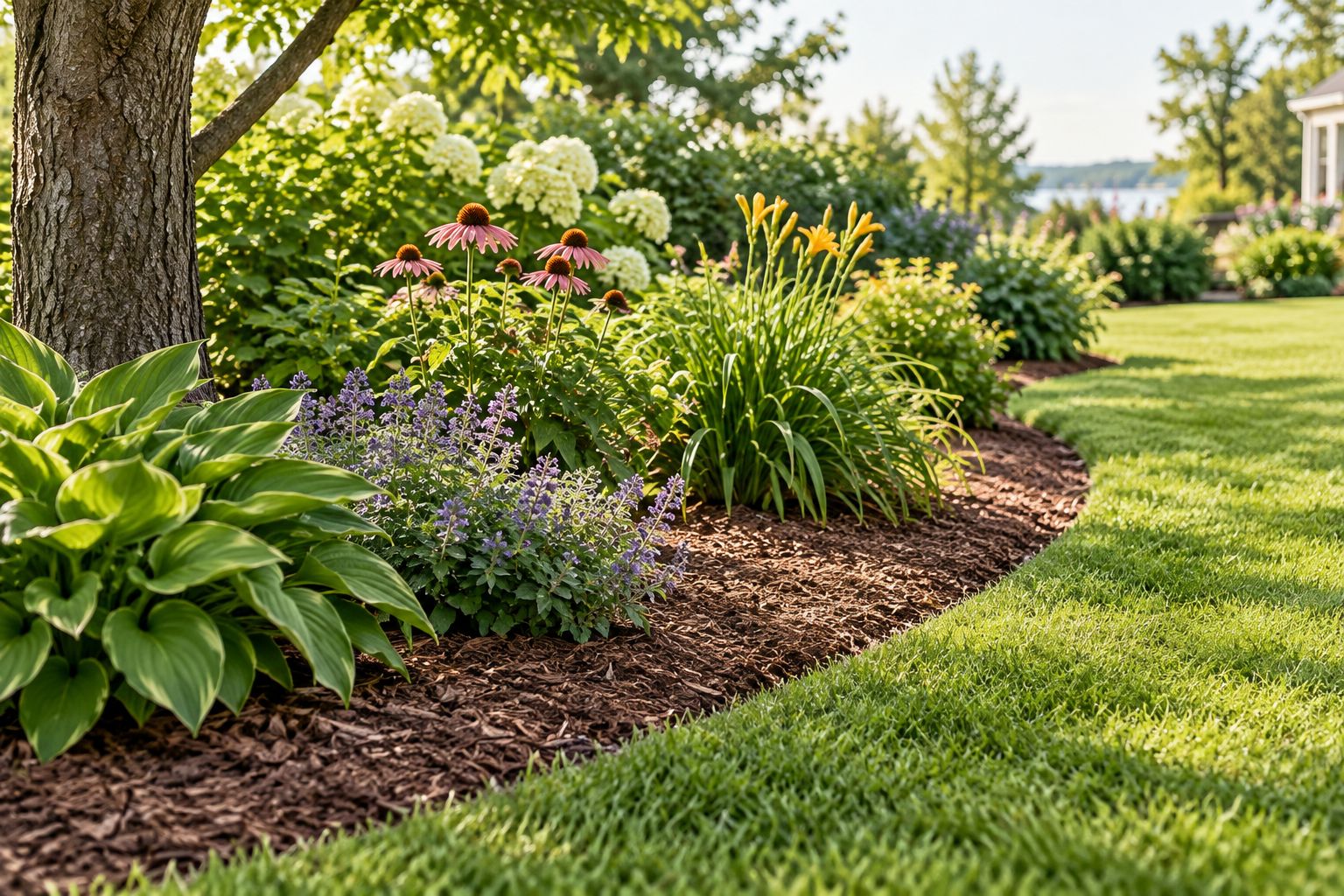
Choose edging for how it works, not just how it looks. An uneven border can become another obstacle, while an inaccessible edge leaves you with hand trimming. Any change should make the next maintenance visit easier.
- Weed the existing bed before applying fresh mulch.
- Check mulch depth before adding more material.
- Keep trunks and plant crowns uncovered.
- Leave access for pruning and removing unwanted growth.
- Avoid adding decorative objects that complicate maintenance.
5. Choose plants and watering methods together
Use the plants already doing well as clues, then assess the site directly. Notice sun exposure, shade, wet spots, and dry areas. A plant suited to those conditions is a better starting point than one chosen only for its flowers.
Low maintenance does not mean maintenance-free, especially during establishment. A drought-tolerant plant still needs appropriate care while its roots develop. Before planting, decide how you will water it without repeatedly carrying heavy containers or dragging a hose across a walkway.
For 2026 planting projects, compare mature size and care needs as carefully as appearance. A compact plant that fits its space avoids a different kind of recurring job: cutting back something that has outgrown the bed. Keep favorite higher-care plants near an accessible place rather than scattering them throughout the yard.
- Match each plant to the site's light and moisture conditions.
- Check mature height and spread before planting.
- Group plants with similar watering needs.
- Keep watering connections accessible from stable footing.
- Plan establishment care before removing existing vegetation.
6. Divide the work before the season gets busy
A written task list works without an app or special equipment. Divide it into work you enjoy, work you want help with, and work the yard no longer needs. This keeps a maintenance plan from becoming an automatic list of extra services.
For your 2026 routine, consider whether a shared arrangement fits better than either extreme. You might keep container gardening and light deadheading while assigning mowing or seasonal cleanup to someone else. Ask about the exact tasks rather than assuming a general service description covers everything.
Grassgrabbers provides lawn care and landscaping services in central Iowa, making it an option for retirees seeking help with yard upkeep. The trade-off is coordination: you still need to explain your priorities, identify plants to keep, and confirm the agreed work. Hand off the work you do not want—not the decisions about how you enjoy your yard.
- Write down the tasks you want to retain.
- Identify work that needs outside help.
- Confirm whether debris removal is included in a proposed scope.
- Explain gates, access restrictions, and areas to leave untouched.
- Revisit the arrangement when your needs change.
Plan a simpler yard routine
Explore lawn care, landscaping, and yard maintenance help for your central Iowa property.
Compare your lawn-care options
The best arrangement depends on which work you want to keep. Compare your physical workload and coordination needs—not just how tidy each option sounds.
| Option | Best for | Main benefit | Key limitation |
|---|---|---|---|
| Do-it-yourself upkeep | Retirees who enjoy yard work and comfortably handle their equipment | Direct control over timing and details | You remain responsible for physical work and equipment care |
| Shared DIY and professional care | Retirees who want to keep gardening but hand off demanding chores | Separates enjoyable tasks from burdensome work | Responsibilities need clear boundaries |
| Professional routine maintenance | Retirees who want help with recurring upkeep | Removes agreed tasks from your own schedule | Work outside the agreement still needs attention |
| Landscape simplification | Retirees whose yard layout creates unnecessary work | Addresses awkward edges, obstacles, and unsuitable planting areas | Changes require planning and establishment care |
These options can work together. A simpler layout does not replace routine maintenance, and professional mowing does not fix an overgrown planting bed unless that work is included.
Common mistakes retirees make
Replacing manageable lawn with too many beds
A planting bed still needs care. Before removing easy-to-mow grass, decide who will handle weeds, mulch, watering, and plant replacement. Keep the lawn if the alternative creates work you do not want.
Buying equipment before checking the task
A new mower does not remove obstacles, improve uneven footing, or make every slope appropriate to mow. Identify the actual problem first. Sometimes changing the layout or assigning the task to someone else is the better decision.
Choosing plants only for their first-season size
A small shrub at planting can become an obstruction later. Check mature dimensions and leave enough space around paths, windows, and other plants. Do not build a retirement routine around repeated corrective pruning.
Asking for general help without defining the work
Lawn care, landscaping, and seasonal cleanup describe different needs. Tell a provider which tasks matter and which areas should remain untouched. Grassgrabbers is one local option to discuss that division of work with; confirm the specific scope before committing.
FAQ
What's the best low-maintenance lawn care for retirees?
The best low-maintenance lawn care for retirees removes difficult chores while preserving the gardening and outdoor activities you enjoy. Start with awkward mowing areas, demanding lifting, and recurring tasks you want someone else to handle.
Should I replace all my grass with landscaping?
No—replacing all your grass is not automatically easier to maintain. Keep useful, accessible lawn and compare the weeding, watering, and pruning needs of any replacement planting.
How high should I mow an Iowa lawn?
For established Kentucky bluegrass or tall fescue, around 3–3.5 inches is a common recommended mowing height. Identify your grass species and avoid removing more than one-third of its blade at once.
Are native plants maintenance-free?
Native plants are not maintenance-free. Choose species suited to your site's conditions and plan for watering during establishment, weed control, and any seasonal care they need.
Is professional lawn care better than buying a new mower?
Professional lawn care is the better fit when your goal is to stop doing the mowing yourself. A new mower still leaves you responsible for operation, storage, maintenance, and deciding which areas are safe to mow.
Can I keep gardening while hiring lawn help?
Yes—you can keep the gardening you enjoy and hire help for other work. Write down the division of responsibilities so mowing, trimming, cleanup, and bed care do not fall between arrangements.
Does Grassgrabbers serve central Iowa homeowners?
Grassgrabbers provides lawn care, landscaping, and yard maintenance to residential property owners in central Iowa. Discuss your property and requested work directly to confirm the appropriate service scope.
One last thing
Before buying anything, walk the route between your outdoor water connection, tool storage, and favorite sitting spot. Look for the small chores hidden in that route: moving a chair to reach the hose, carrying tools around a bed, or trimming a narrow strip nobody uses.
The best first change is often removing a repeated task, not adding a new feature. Make that your starting point, then decide what help you need.